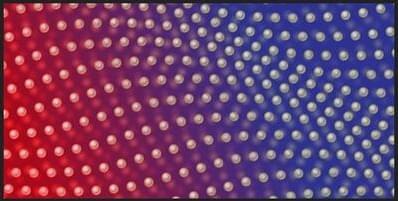
Temperature is a tuning knob for semiconductor-band-gap energies, which in turn play a key role in the performance of optoelectronic devices. But computational tools for predicting this temperature dependence from first principles struggle to capture the influence of one main factor: many-electron effects in electron–phonon interactions. Xiaoxun Gong at the University of California, Berkeley, and colleagues now demonstrate a computational framework that properly accounts for these effects [1]. Their framework could aid the design of materials and devices with precisely tailored electronic and optical properties.
Theoretical calculations consistently underestimate the strength of electron–phonon interactions and how they modify band gaps at different temperatures. Previous studies indicated that this discrepancy likely stems from insufficient treatment of many-electron effects. To quantify the role of electron–phonon interactions more accurately, Gong and his colleagues have proposed a new framework that breaks down the total temperature-dependent modification of the band gap into various contributions. Within this framework, they analyzed electron–phonon interactions using a many-body perturbation theory, in which electrons’ energies and their perturbation by phonons are captured by the “GW” approximation.
To test their framework, the researchers computed the band gaps of diamond, silicon, and gallium phosphide at different temperatures. They found that the temperature-dependent band-gap modification was enhanced using the GW-based perturbation theory—especially compared to a description based on density-functional theory (DFT), the workhorse tool for first-principles electronic calculations. The new predictions for all three materials showed excellent agreement with previous measurements.