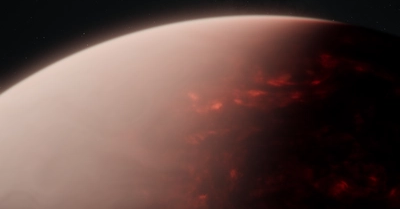
A scorching “lava world” once thought barren may actually be wrapped in a thick, mysterious atmosphere. Astronomers have uncovered surprising evidence of a thick atmosphere surrounding TOI-561 b, a scorching, fast-orbiting rocky planet once thought too extreme to hold onto any gas. Using NASA’s James Webb Space Telescope, researchers found the planet is far cooler than expected for a bare rock, hinting at a heat-distributing atmosphere above a churning magma ocean. This strange world—where a year lasts just over 10 hours and one side is locked in eternal daylight—may even be rich in volatile materials, behaving like a “wet lava ball.”
A team of astronomers led by Carnegie has uncovered the clearest evidence yet that a rocky planet outside our Solar System has an atmosphere. Using NASA’s James Webb Space Telescope (JWST), the researchers identified signs of gas surrounding an unusual target: an ancient, extremely hot super Earth that likely has a surface covered by molten rock. The findings were published in The Astrophysical Journal Letters.
The planet, known as TOI-561 b, has about twice the mass of Earth but is dramatically different in almost every other way. It orbits extremely close to its star, at a distance just one fortieth that of Mercury from the Sun. Even though its star is slightly smaller and cooler than our Sun, the planet’s tight orbit means it completes a full year in only 10.56 hours. One side constantly faces the star, leaving it locked in permanent daylight.