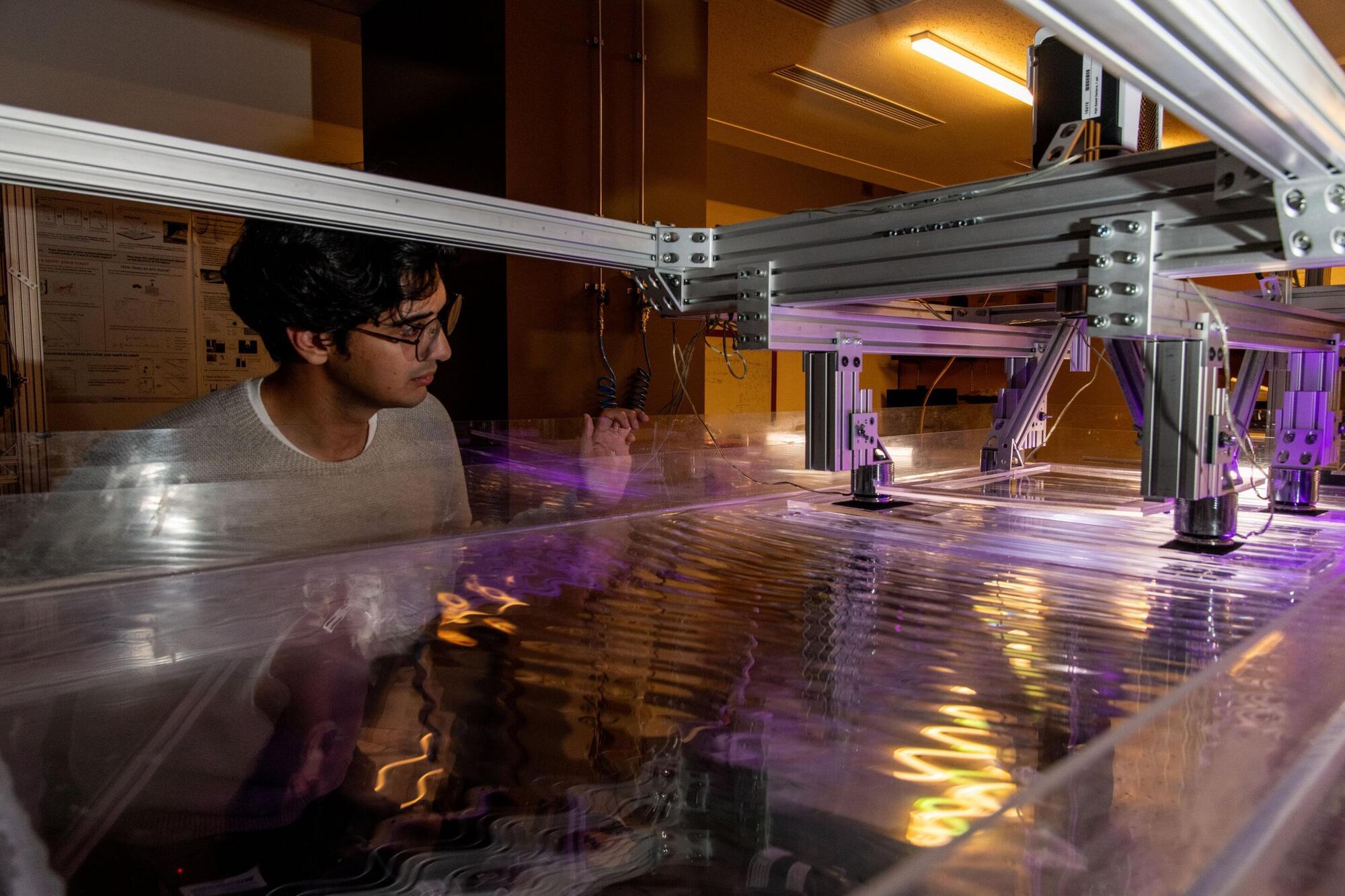
In the quirky quantum world, particles can be affected by forces that they never directly encounter. A classic example is the Aharonov–Bohm (AB) effect, where electrons are affected by a magnetic field, despite not passing through it. Although predicted in 1959, it took more than two decades to confirm this effect experimentally, as the specific changes to the electrons’ wave properties could only be inferred indirectly, and with great difficulty. Now, physicists from the Okinawa Institute of Science and Technology (OIST), in collaboration with the University of Oslo and Universidad Adolfo Ibáñez, have used a classical fluid analog that mimics and extends the AB effect using a simple platform: a water tank.
In work published in Communications Physics, researchers have revealed that when water waves are sent towards a swirling vortex from opposite directions, it causes a striking pattern, with one or more lines of momentarily still water radiating outward and rotating in an almost hypnotic way.
“This was something new and unexpected,” says Aditya Singh, a Ph.D. student in the Nonlinear and Non-equilibrium Physics Unit and co-first author of the study. “That’s what makes this fluid analog system so valuable. It reveals topological effects—wave behaviors that occur across the whole system—that can’t be seen in quantum experiments.”