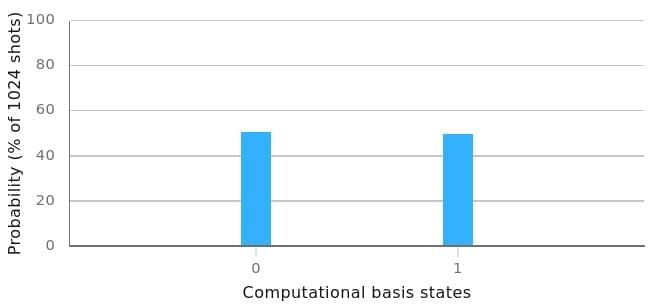
Let’s say you have a probabilistic computer with a single bit of memory. Some algorithms on the computer will stochastically flip the single bit of memory such that its new value will be uniformly distributed with a 50% chance of being 0 and a 50% chance of being 1. Other programs will place it into a degenerate distribution, meaning it either has 100% chance of being 0 every time you run the program, or other programs will produce 1 100% of the time.
A magician tells you to run one of the programs in one of the two categories of your choosing and then copy the computer’s memory state onto a thumb drive and hand it to him. You pick one, run the program, copy the bit of the memory to your thumb drive, then hand it to the magician. The magician then does something with the thumb drive you cannot see, then looks up at you and tell you exactly what category the program you ran to produce that bit came from.
Curious, you repeat this many times over: you run a program from one of the two categories (degenerate or uniform), copy the bit value produced from the algorithm, and then hand the thumb drive to the magician. Each and every time he always correctly guesses which category of program was ran to produce it.