Superconducting qubits—bits of quantum information—have been widely considered a promising technology for moving quantum computing forward. But there’s still much work to be done before they can be brought out of a near absolute zero temperature environment. The lab of Professor Hong Tang has recently published two studies that advance the technology.
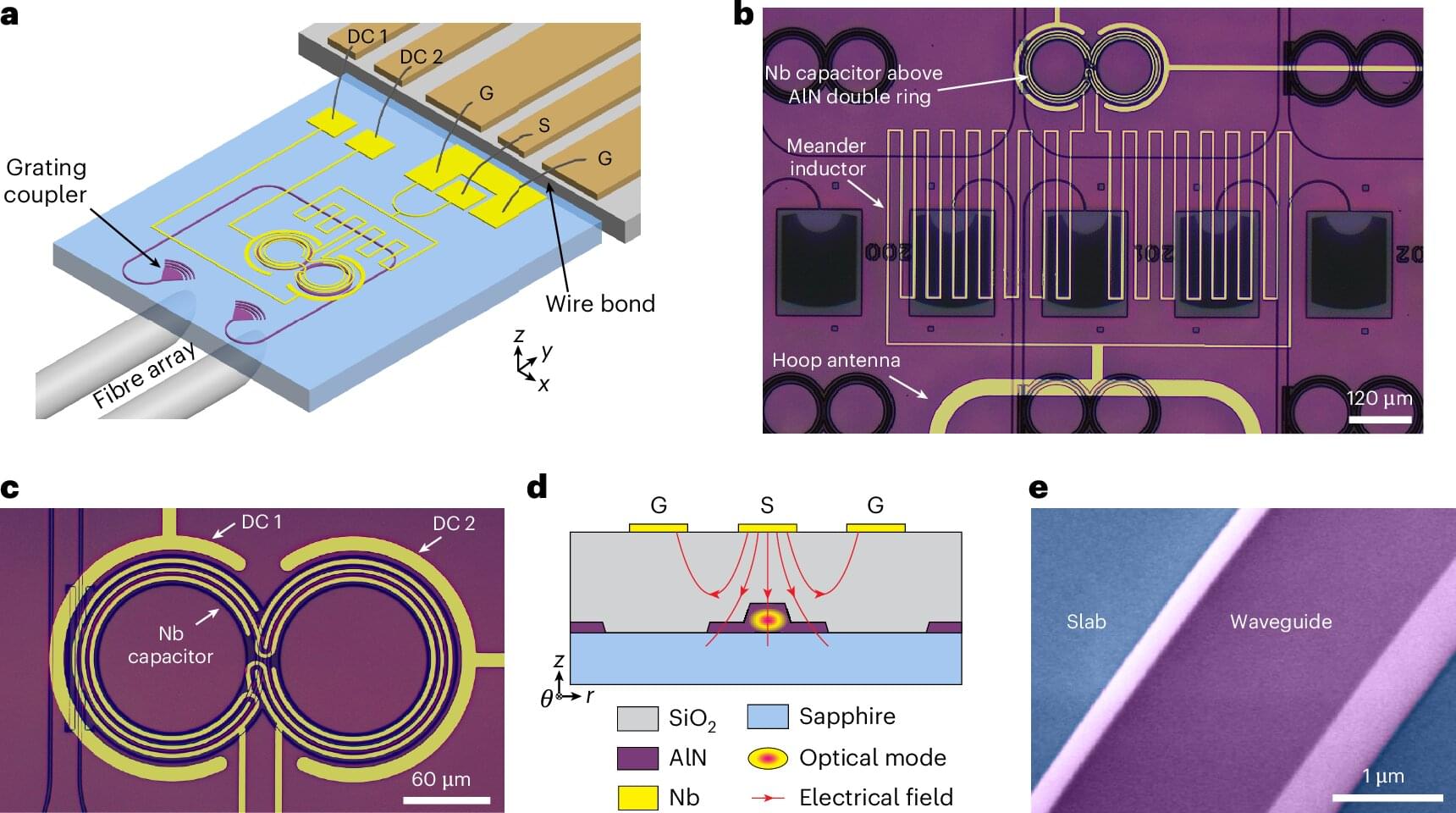
To solve practical problems, quantum processors need a lot of qubits—up to thousands to millions. Such a large number of qubits requires significantly complex wiring and a way to store them at a temperature colder than deep space. This is complicated by the physical size of the cryogenic devices, known as dilution refrigerators, that maintain qubits at a temperature just above absolute zero. In a study published in Nature Photonics, Tang’s research team has found a way around this obstacle.
A flexible and cost-effective solution is to build a quantum network by connecting qubits inside separate refrigerators. Connecting qubits with standard coaxial cables, however, wouldn’t work if those cables were kept in a room temperature environment. And storing them all in one very cold room would be near impossible. Even under an optimistic assumption of 1,000 qubits per refrigerator, scaling to 1 million qubits would require linking 1,000 refrigerators—an arrangement that is physically impractical within a single room.