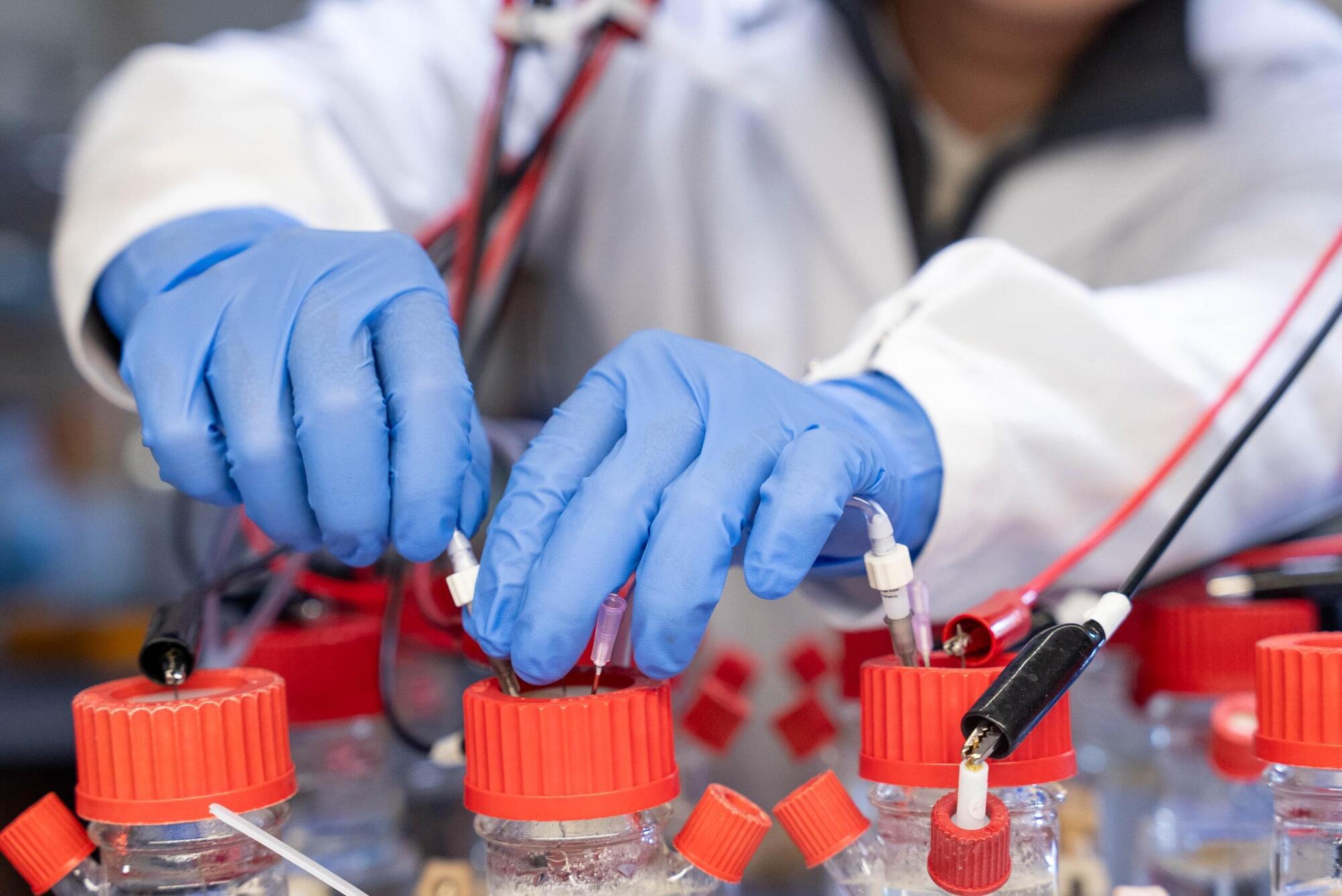
Bacterial sensors usually rely on emitting light to transfer information about what they’re sensing, but that method isn’t practical in many settings. That’s why most information transmission is done via electricity. And while electricity-emitting bacteria exist, manipulating them into useful sensors has been quite challenging. Rice University professor Caroline Ajo-Franklin’s group, working in collaboration with researchers from Tufts University and Baylor College of Medicine, recently developed a flexible bioelectrical sensor system called electroactive co-culture sensing system (e-COSENS). The study is published in Nature Biotechnology.
“Bioelectrical sensing is by no means a new concept,” said Ajo-Franklin, the Ralph and Dorothy Looney Professor of Biosciences and corresponding author on this paper. “But e-COSENS is the first system that allows us to easily engineer bioelectronic sensors in a modular manner, like assembling Legos, allowing us to potentially use them to monitor everything from human health to environmental contaminants.”
Bioelectrical sensing requires bacteria that produce electricity and are easy for researchers to manipulate to respond to different substances. Ideally, the bacteria would be able to live in a variety of different places so that the system could be used in environments ranging from rivers to milk.