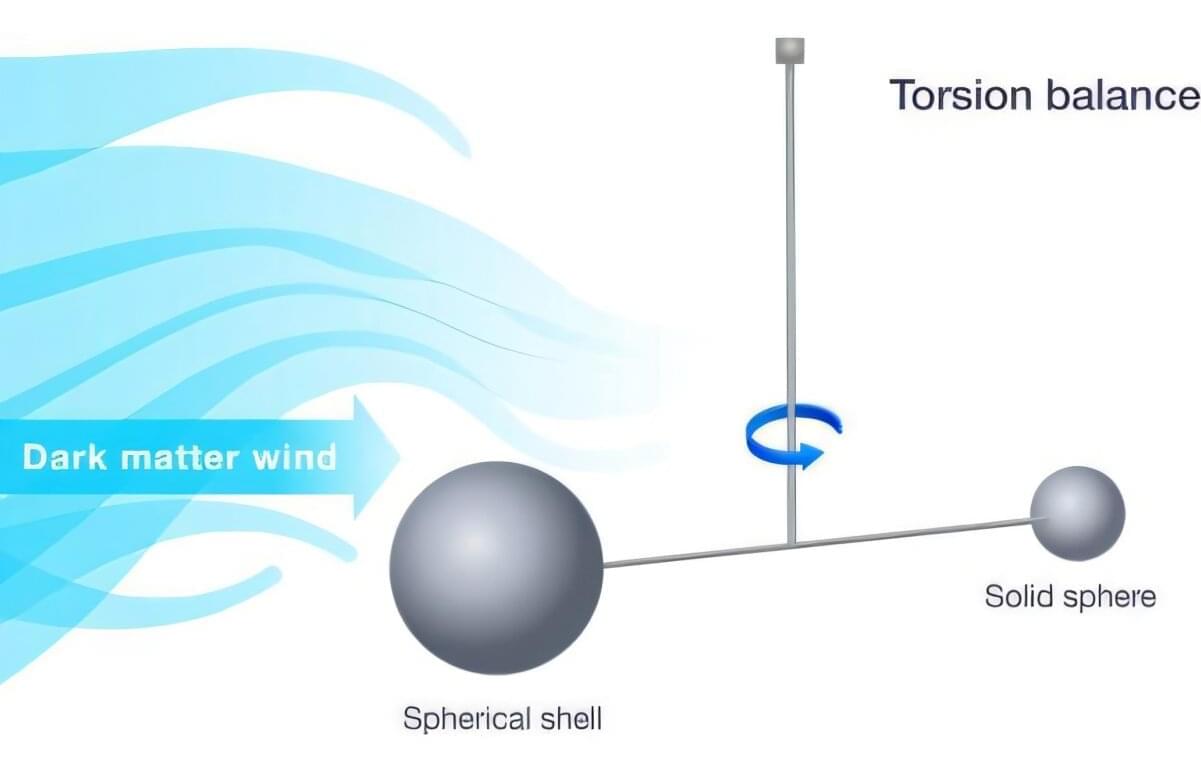
Dark matter is believed to make up a large fraction of the matter in the universe, yet its true nature remains unknown. Most past experiments have focused on heavier dark matter candidates, while much lighter dark matter, with masses closer to the mass of a neutrino, has been difficult to detect directly because its scattering signals are extremely weak.
An international team of researchers has found that torsion-balance experiments —precision instruments originally built to test the equivalence principle—can double as detectors for very light dark matter. The study, published in Physical Review Letters, provides the strongest direct detection limits to date on interactions between dark matter and nucleons in this mass range from about 0.01 to 1 eV.
The team of researchers, including The University of Tokyo Kavli Institute for the Physics and Mathematics of the Universe (Kavli IPMU, WPI) Professor Shigeki Matsumoto and Kavli IPMU Todai Postdoctoral Research Fellow and JSPS Fellow Jie Sheng, focused on one key physical effect: when dark matter is sufficiently light, its number density in a galaxy becomes very high, and its scattering cross section with macroscopic objects can also be greatly enhanced by coherent effects.