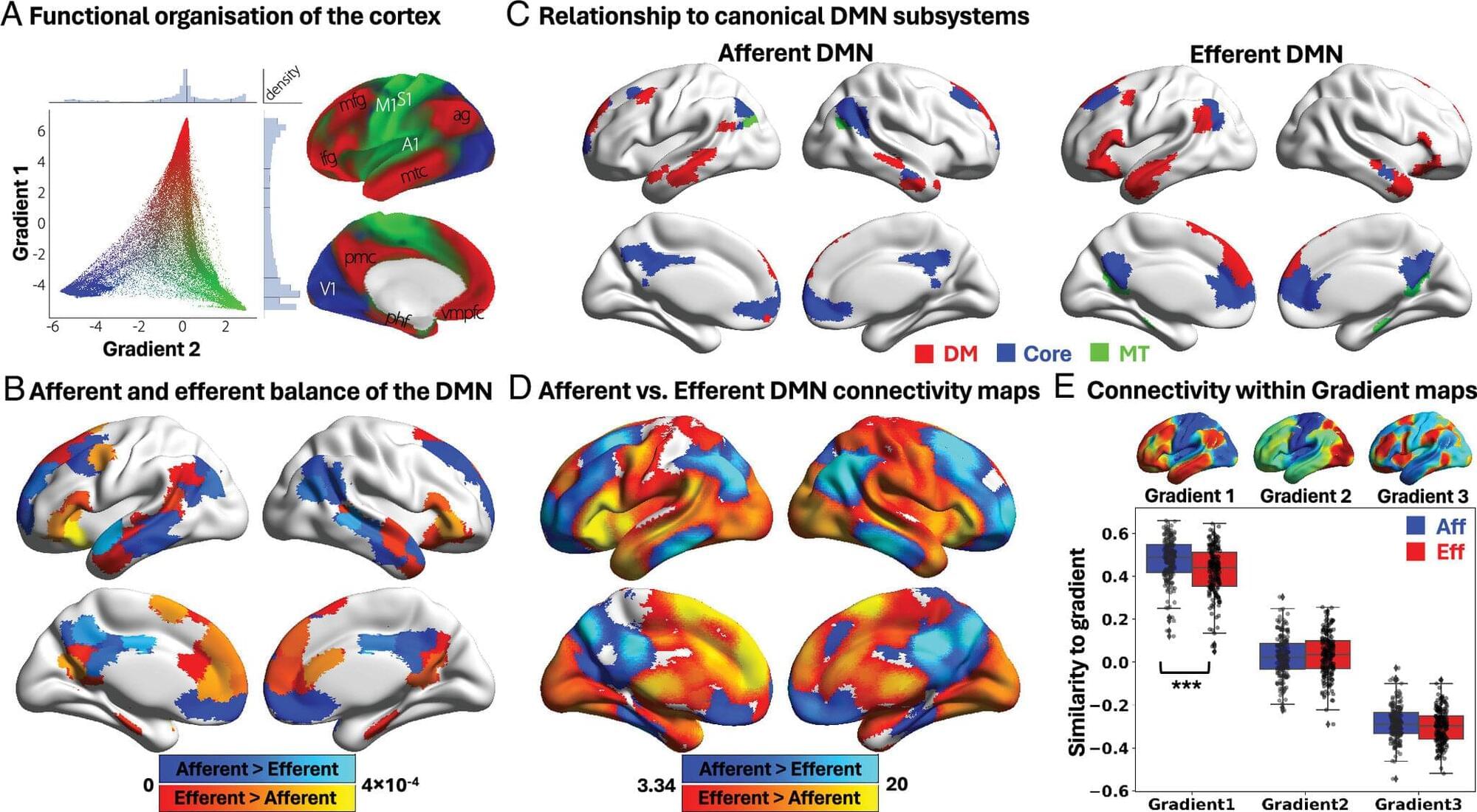
The default mode network (DMN) is a distributed set of interconnected brain regions that has long been associated with internally oriented cognition, such as remembering the past, thinking about the future, or thinking about oneself. Accumulating evidence also indicates that the DMN is engaged during tasks involving external perceptual input, such as language comprehension and social perception. However, the mechanism by which the same network supports both internally and externally oriented cognition has remained unknown.
Now, a research team led by Zhang Meichao from the Institute of Psychology of the Chinese Academy of Sciences (CAS) has identified an organizational principle within the DMN that helps explain how the network supports both internal and external cognition.
The study, published in PNAS, reveals that distinct subregions within the DMN act as “senders” and “receivers” of information, enabling flexible shifts between perception and memory-driven thought.