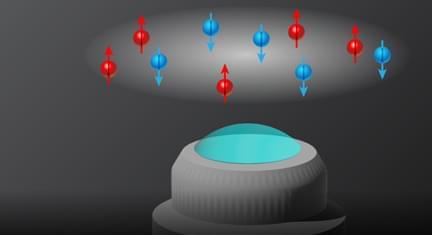
Snapshot measurements of cold-atom gases reveal hidden spin correlations that could force an update of some superconductivity theories.
Our understanding of nature is inherently bound to the experimental tools we build to observe the world. Superconductivity, for example, has been traditionally studied using current and voltage meters under a variety of temperatures and other environmental conditions. From these observations, theorists have developed models—notably the Bardeen-Cooper-Schrieffer (BCS) theory, which assumes that the zero-resistance flow in a superconductor arises from electrons forming so-called Cooper pairs. This theory has been successful in explaining a large class of superconductors, but Tarik Yefsah from the Ecole Normale Supérieure in Paris and colleagues have now observed behavior that contradicts BCS predictions [1]. Using a recently developed technique called atom-resolved continuum quantum gas microscopy, the researchers directly observed spatial correlations in cold atoms that mimic superconducting electrons.