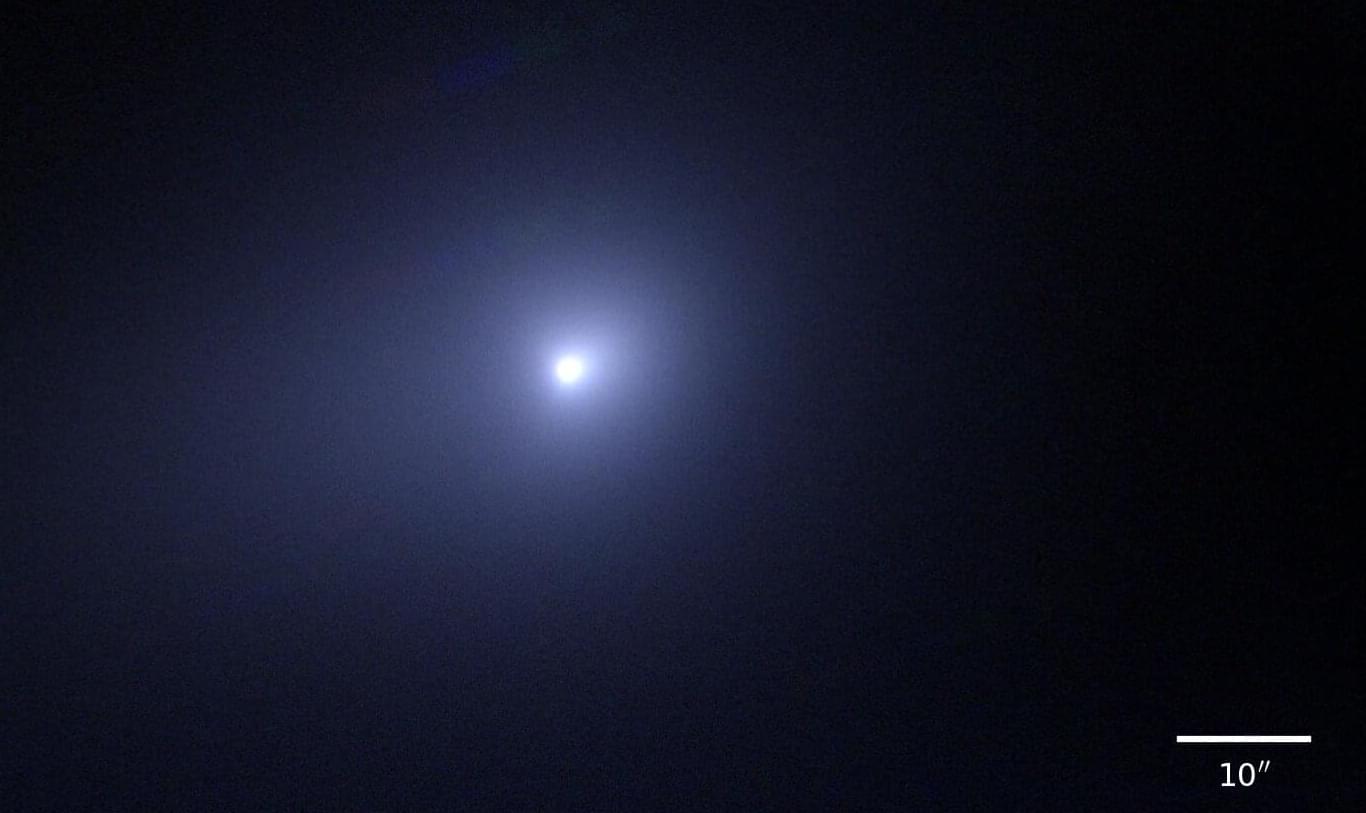
The Subaru Telescope observed the interstellar comet 3I/ATLAS on January 7, 2026, after it made its closest approach to the sun. By observing colors in the coma around the comet, astronomers could estimate the ratio of carbon dioxide to water. This ratio is much lower than that inferred from earlier observations by space telescopes. These findings suggest that the chemistry of the coma is evolving over time and offers clues to the structure of comet 3I/ATLAS. The work appears in The Astronomical Journal.
Comet 3I/ATLAS (C/2025 N1) has garnered much attention as a comet which originated outside of the solar system. A research group led by Yoshiharu Shinnaka of the Koyama Space Science Institute, Kyoto Sangyo University, used the Subaru Telescope to observe comet 3I/ATLAS after perihelion, the comet’s closest approach to the sun. The team applied analytical methods and expertise accumulated through investigations of solar system comets to the data.
From this analysis, the team was able to estimate the ratio of carbon dioxide (CO2) to water (H2O) in the coma, the cloud of gas around the nucleus of the comet. Because the gas in the coma comes from the nucleus, the coma composition provides hints to the composition of the nucleus.