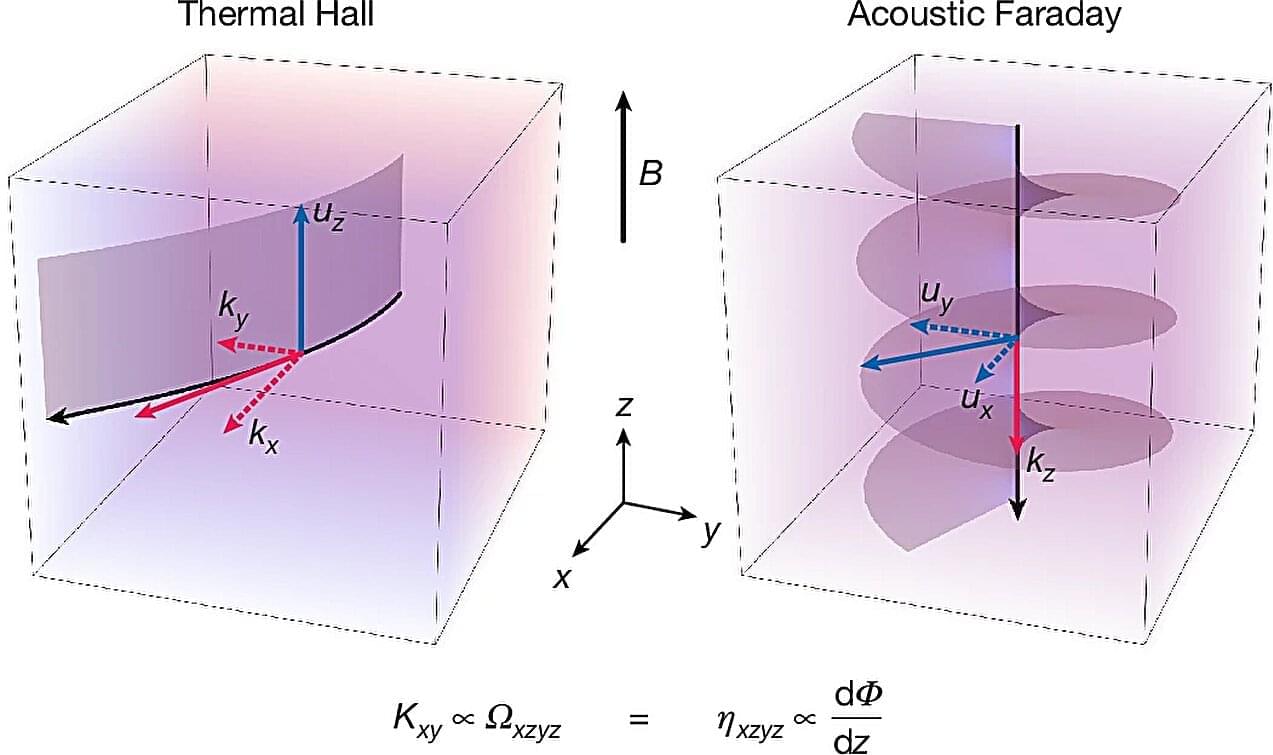
It was a head-spinning discovery. In 2018, researchers in Japan claimed to find concrete evidence of an elusive particle, a Majorana fermion, in a quantum spin liquid called ruthenium trichloride. Majoranas are highly sought-after by quantum materials scientists because when a pair are localized, or trapped, they can securely encode information and form a stable qubit—the building block of quantum computing.
Some researchers heralded the finding and used it to launch their own studies, while others believed the breakthrough—which was made by measuring what’s called the thermal Hall effect—was actually a mirage caused by defects in the material sample.
Cornell researchers have now waded into the debate and their findings, published in Nature, show both camps were wrong. By measuring the movement of sound waves rather than the flow of heat, the team discovered the thermal Hall effect was caused by rotating lattice vibrations called chiral phonons.