Despite its small size—typically only several inches, beak to tail—the zebra finch is a remarkable learner. A songbird native to Australia, it’s renowned for its ability to pick up new songs.
That talent has made it a favorite of scientists studying how animal brains imprint new skills, particularly vocal learning, or the capacity to perfect new sounds. And now researchers at Boston University have discovered another quirk to the zebra finch brain—one that could also have implications for understanding our own gray matter.
In a study that looked at the bird’s brain in unprecedented detail, they uncovered new insights into a mechanism known as neurogenesis—the birth, migration, and maturation of neurons—that may help the brain learn, add new skills, and restore and repair itself.
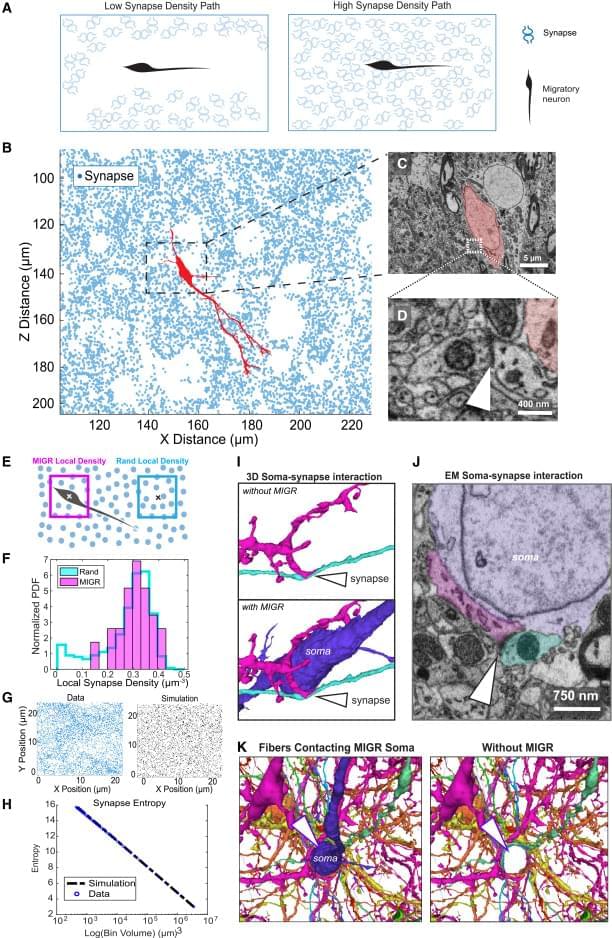
Observing the finch brain using a high-powered microscope, the researchers watched as new neurons bullied their way through the brain en route to bolstering existing circuits and connections. They’d expected the neurons to gingerly step around established brain structures, including more mature brain cells, to better preserve them; instead, they saw the neurons tunnel right through, squishing and shoving as they went. That may help the birds learn new things or repair damage, but it could also come with a cost to existing cells and memories.
According to the BU-led team, their findings could help explain why neurogenesis may not occur in humans beyond the womb, increasing our vulnerability to a range of brain disorders. The findings were published in Current Biology.
Abstract: Current Biology
Read More
Shvedov et al. use electron microscopy-based connectomics to characterize migrating immature neurons in the adult songbird striatum. These new neurons make extensive contacts with mature neurons and appear to physically deform surrounding axons, dendrites, and cell bodies, suggesting that neuron migration may physically reshape established circuitry in the adult brain.