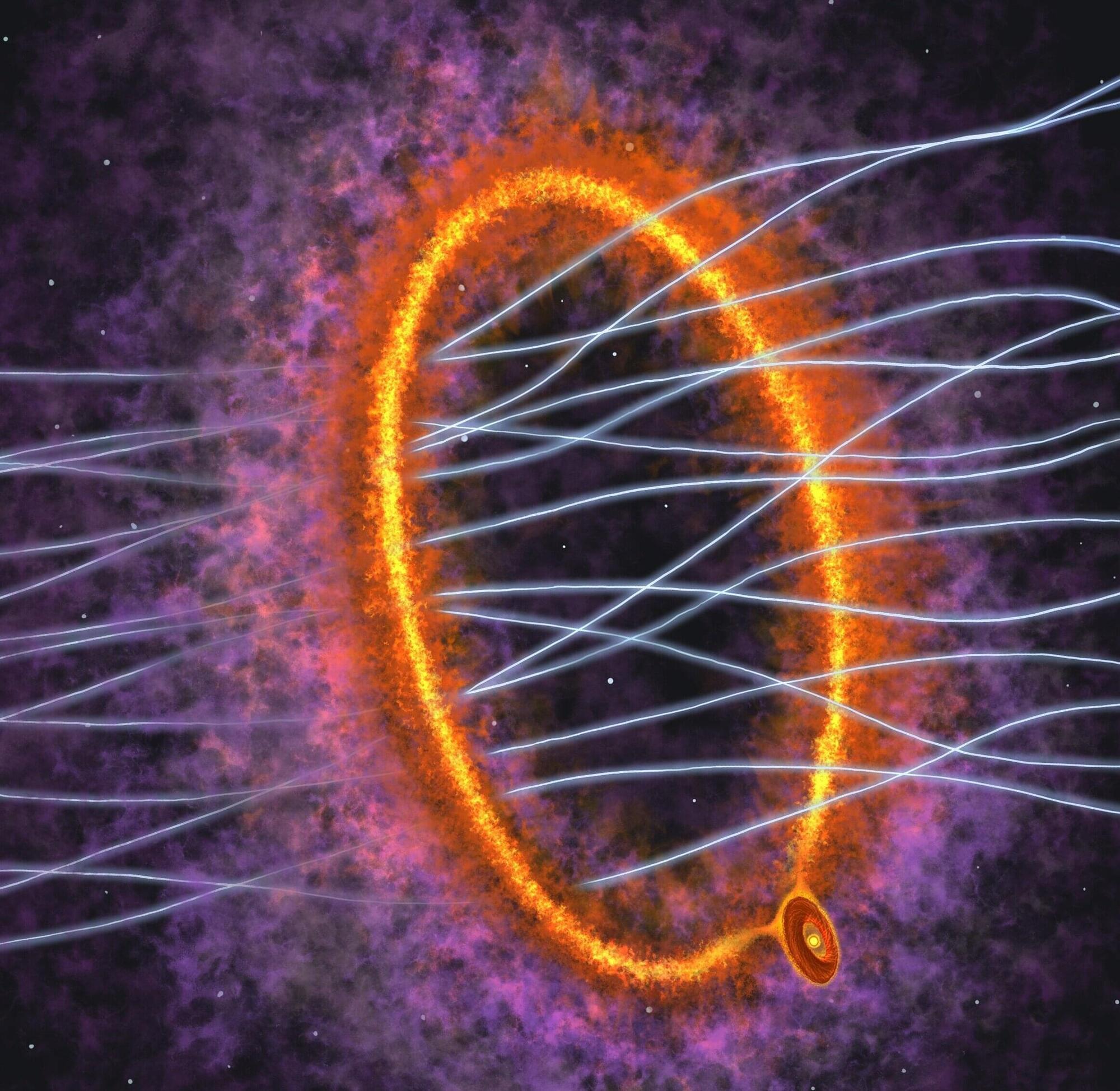
Researchers have uncovered new insights into the early development of baby stars. As published in The Astrophysical Journal Letters, a research team from Kyushu University and Kagawa University reports that during the early growth period of a baby star, the protostellar disk—the dense disk of gas and dust that surrounds the star—expels magnetic flux and forms a giant warm ring of gas about 1,000 au (astronomical units) in size. The research team explains that these “sneezes” of matter and magnetic energy help the baby star release excess energy, leading to proper star formation.
One of the many mysteries that the universe holds is how stars like our sun are born. Stars are born in areas of the cosmos called stellar nurseries, where gas and dust coalesce to form early stars called protostars. The best way to understand star formation is to observe these stellar nurseries. However, this can be difficult due to the aforementioned gas and dust obscuring the baby star.
“Thankfully, one of the most promising ways to get a clear view of protostars is to use the Atacama Large Millimeter/submillimeter Array (ALMA) in Chile,” explains Professor Masahiro N. Machida of Kyushu University’s Faculty of Science, who led the study. “This radio telescope lets us see the different materials that make up stellar nurseries.”