Background Raised cardiac troponin-I is a common finding in patients hospitalised with acute viral infections, including but not limited to COVID-19. This often occurs in the absence of overt myocardial injury presenting a challenge for interpretation. The mechanisms underlying troponin elevation are uncertain.
Methods The CISCO-19 (Cardiovascular Imaging in SARS-CoV-19) study (NCT04403607) is a prospective, multicentre cohort study, in which hospitalised PCR-confirmed COVID-19 participants (N=267) underwent multisystem evaluation at enrolment and at 28–60 days. The study incorporated plasma proteomics (SOMAscan V.4.1), cardiovascular MRI and clinical biomarkers. Of these, 211 had baseline plasma proteomic data and 185 completed follow-up sampling. Matched proteomic and imaging data were available for 155 participants (mean age: 55 years (SD 12); 43% female).
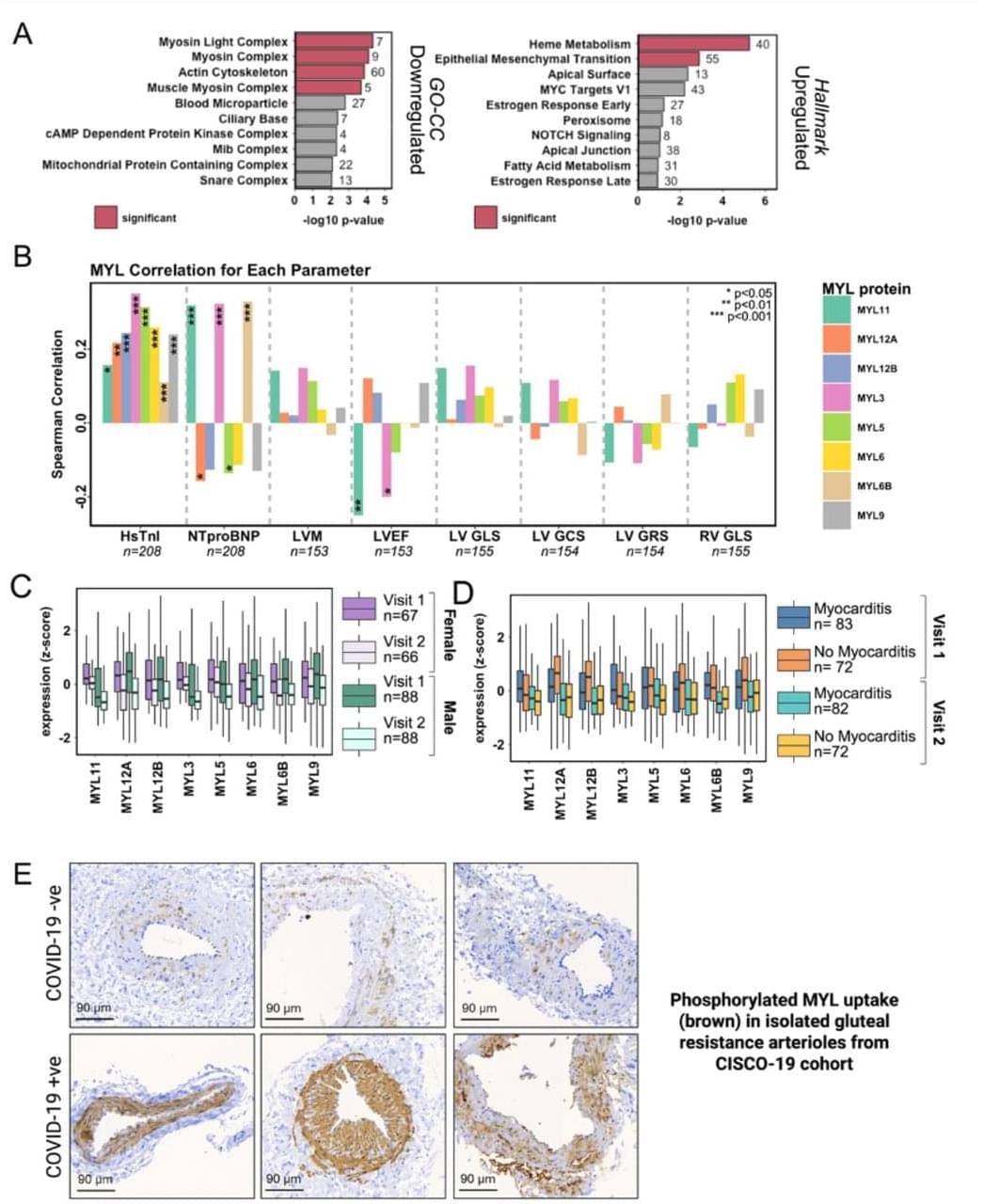
Results A high likelihood of myocarditis was identified in 13.2% (N=21/159) of participants. High-sensitivity troponin-I was modestly elevated at enrolment (median 3 ng/L; IQR 2–6; n=159). Among males (n=90), 9.3% had a high-sensitivity troponin that exceeded 34 ng/L. Among females (n=69), 4.5% exceeded 16 ng/L. Smooth muscle myosin light chain proteins were downregulated at follow-up (log2 fold change −0.12 to −0.6; all adjusted p0.02) and positively correlated with high-sensitivity troponin-I, but not N-terminal brain natriuretic peptide or cardiac MRI indices (n=155).