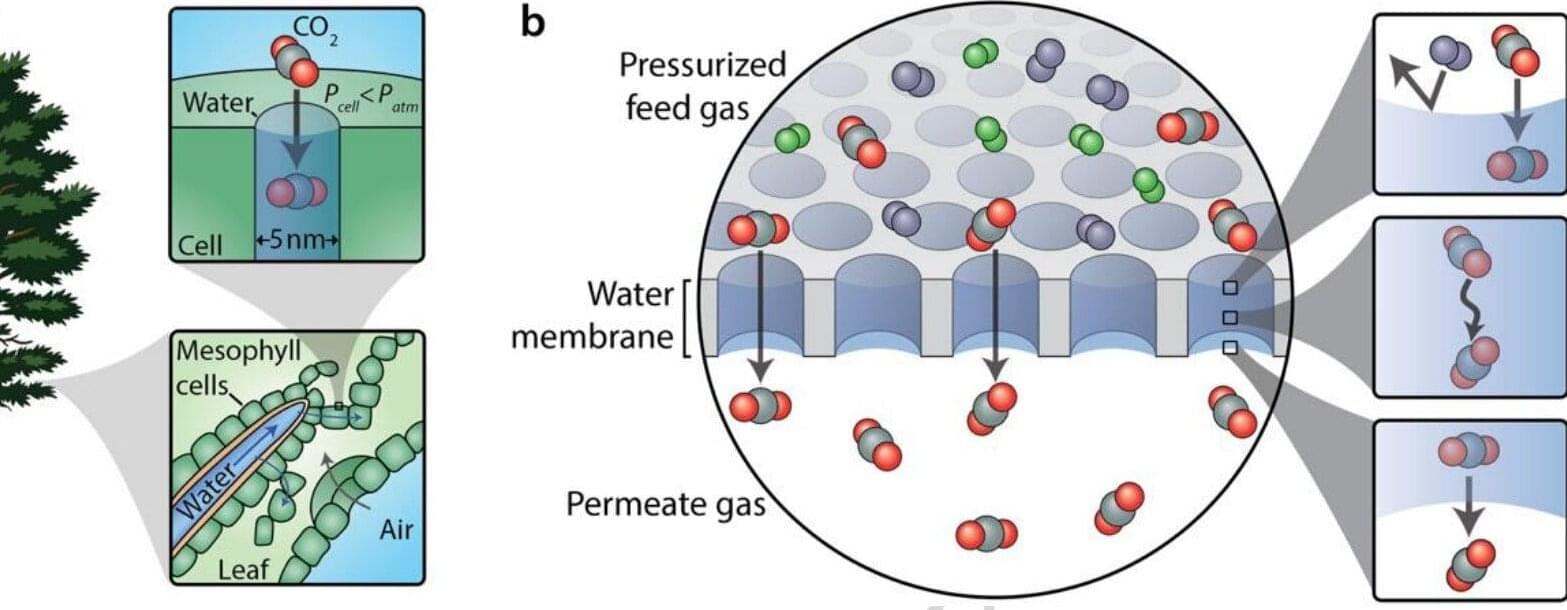
Gas separation membranes are vital for carbon capture, biogas upgrading, and hydrogen purification, all of which require the separation of carbon dioxide from gases like nitrogen, methane and hydrogen. However, the membranes currently in use for these applications suffer from limitations like low throughput or performance under high pressure and humidity, low gas flow, instability, and reaction rate limits.
Plants may have inspired a solution to many of these issues with the way their leaves absorb CO2. In a new study, published in Nature Communications, a team of researchers tests out a plant-inspired, water-based membrane that offers highly selective and permeable gas separation that outperforms many other materials, while also providing a greener, safer, and potentially cheaper way to capture CO2 and purify gases.