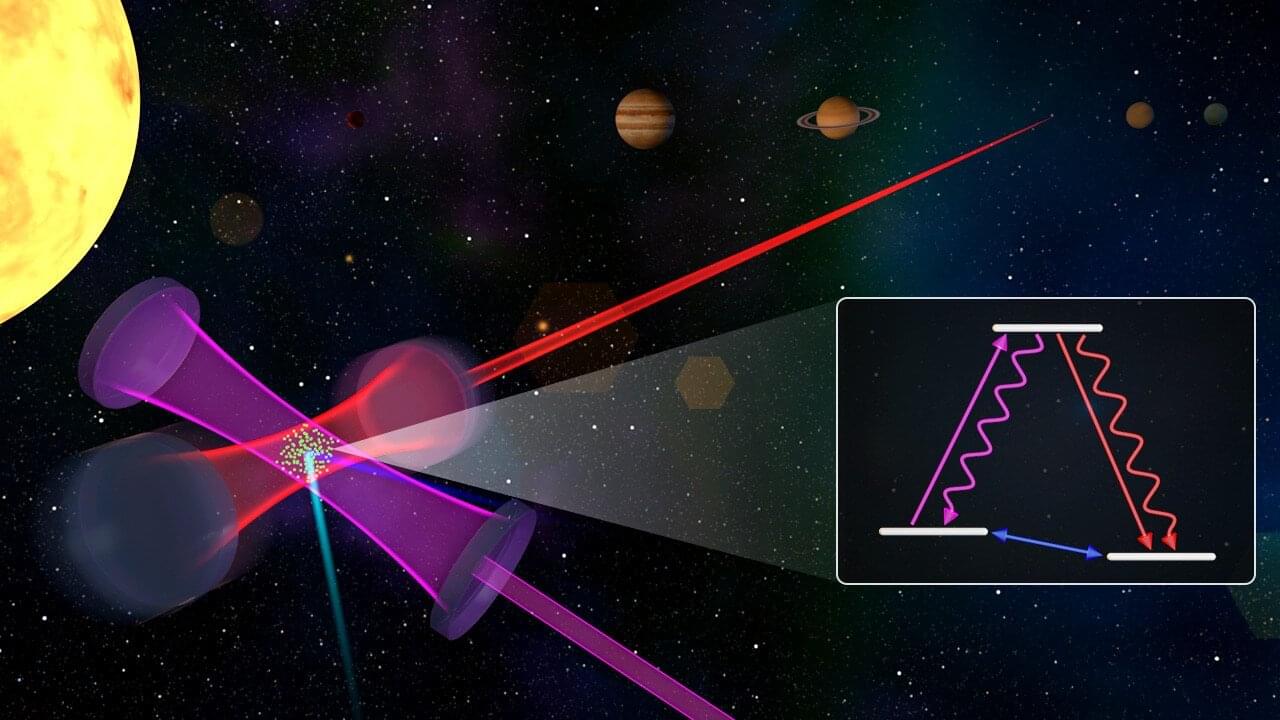
Researchers in the US and Germany have unveiled a theoretical blueprint for an atomic clock driven by a highly synchronized laser, where atoms work in concert rather than independently. Publishing their results in Physical Review Letters, Jarrod Reilly at the University of Colorado, Simon Jäger at the University of Bonn, and their colleagues in the US and Germany revived an idea first proposed in the 1990s—possibly charting a course toward the narrowest-linewidth lasers ever achieved.
In a conventional laser, a mirrored cavity bounces light back and forth between atoms, building up a bright, coherent beam. A superradiant laser works differently: rather than relying on the cavity to maintain coherence, the atoms themselves act as single coordinated emitters, collectively synchronizing their light emission.
Following early theoretical ideas emerged in the 1990s, the concept didn’t gain concrete traction until 2008, when researchers at the University of Colorado proposed that superradiant lasers could serve as a new kind of atomic clock.