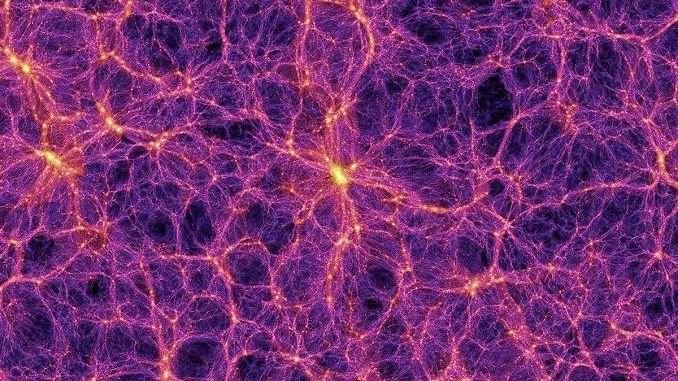
There’s something quietly unsettling about placing a photograph of a human neuron next to a simulated image of the large-scale cosmic web. The two look almost identical: delicate, branching filaments connecting dense clusters, with vast open spaces in between. One fits inside your skull. The other stretches across billions of light-years. The resemblance is hard to dismiss, and for a growing number of researchers, it’s far more than a visual coincidence.
What started as a striking observation in cosmology and neuroscience has evolved into a serious theoretical question. Could the universe, at its most fundamental level, operate the way a brain does? The ideas being put forward aren’t purely philosophical. Some of them come with testable mathematics, published peer-reviewed papers, and the names of well-regarded physicists attached. What follows is an honest look at where the science currently stands.
The estimated 200 billion detectable galaxies aren’t distributed randomly, but are lumped together by gravity into clusters that form even larger clusters, which are connected to one another by “galactic filaments,” long thin threads of galaxies. This vast architecture is what scientists call the cosmic web. When you zoom far enough out, the structure of the entire observable universe begins to take on a shape that looks startlingly familiar.