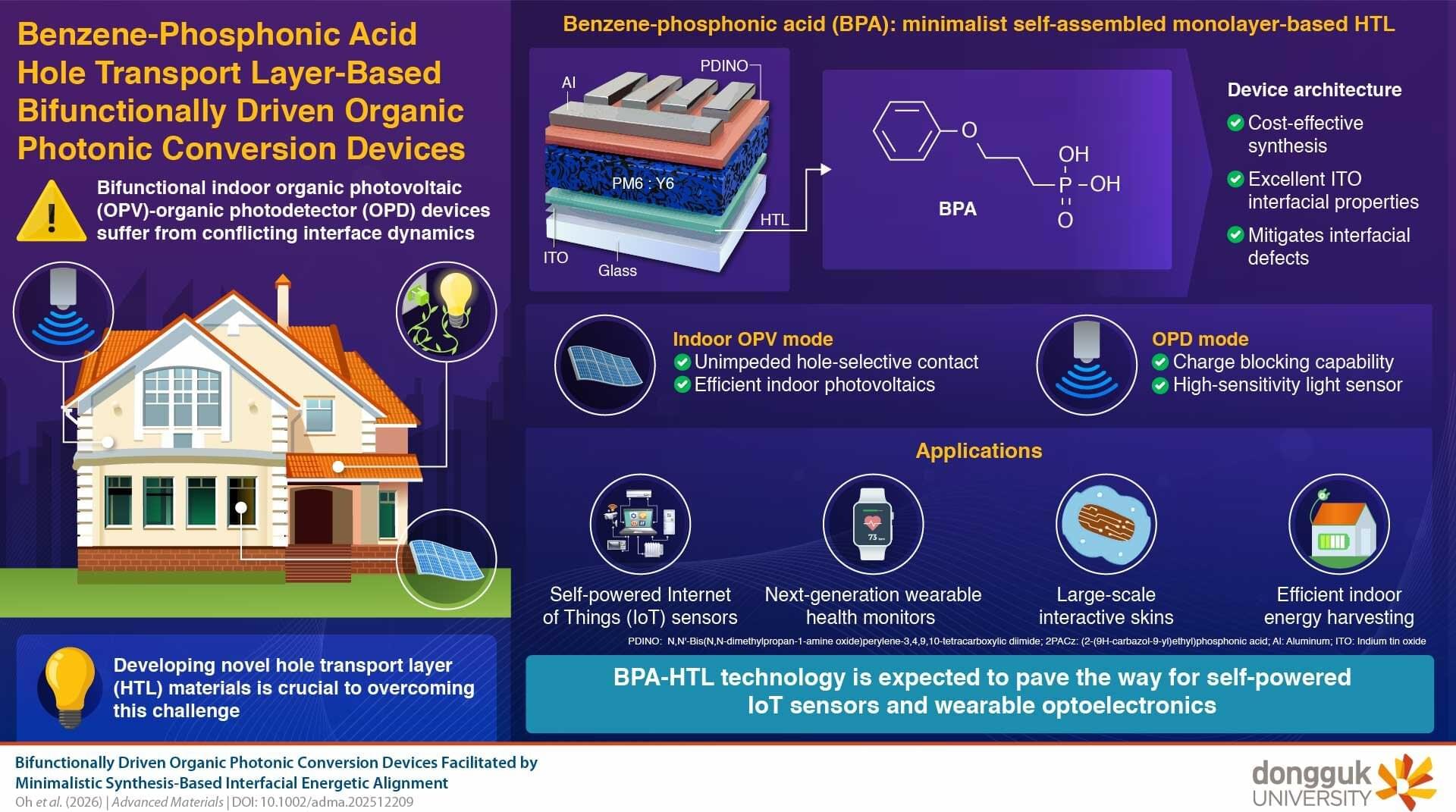
Next-generation optoelectronic systems (devices that convert light to electrical energy) leverage organic semiconductor-based indoor energy-autonomous architectures for cutting-edge applications. Notably, organic semiconductors possess mechanical flexibility, solution processability, and bandgap-tunable optoelectronic properties, making them highly lucrative for indoor power generation via organic photovoltaics (OPVs), as well as for spectrally selective photodetection through organic photodetectors (OPDs). Unfortunately, technological progress made in the fields of OPVs and OPDs has largely been separate, necessitating further research for the development of bifunctional OPV-OPD systems for concurrent energy harvesting and photodetection.
Additionally, the potential self-powered operation of such systems is restricted by conflicting charge transport kinetics, especially in the electron and hole transport layers (ETLs and HTLs, respectively). This limitation impacts device durability and stability and increases fabrication costs, making it indispensable to find new HTL materials such as poly(3,4-ethylenedioxythiophene), 2-(9H-carbazol-9-yl)ethyl]phosphonic acid self-assembled monolayer, MoOx, NiOx, and V2O5, beyond conventional options.