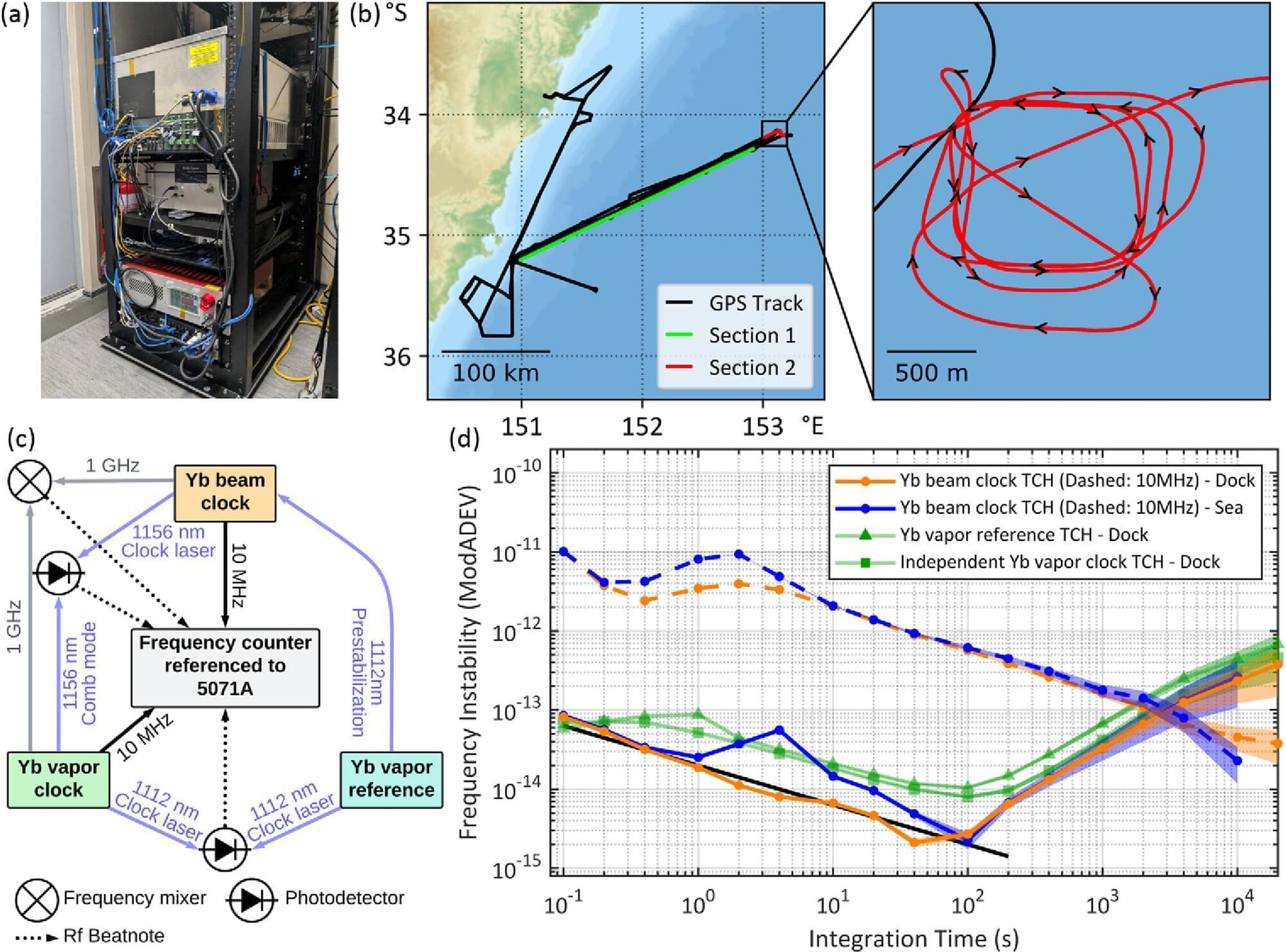
Adelaide University researchers have successfully tested a new type of portable atomic clock at sea for the first time, using technology that could help power the next generation of navigation, communications and scientific systems. The research team, from the Institute for Photonics and Advanced Sensing (IPAS), developed the highly precise device and trialed it aboard a vessel provided by the Royal Australian Navy in July 2024. They have reported their findings in a new paper published in the journal Optica.
Atomic clocks are the world’s most accurate timekeepers and are essential for technologies such as GPS navigation, telecommunications networks and radio astronomy. However, most high-performance atomic clocks operate in carefully controlled laboratory environments and are not designed to be easily transported or used in challenging real-world conditions. The newly developed device changes that.
Photonics researchers created a portable optical atomic clock that uses laser-cooled atoms of the element ytterbium to keep time with extreme precision. By cooling the atoms with lasers and measuring a very specific atomic transition, the clock can track time far more accurately than conventional systems.