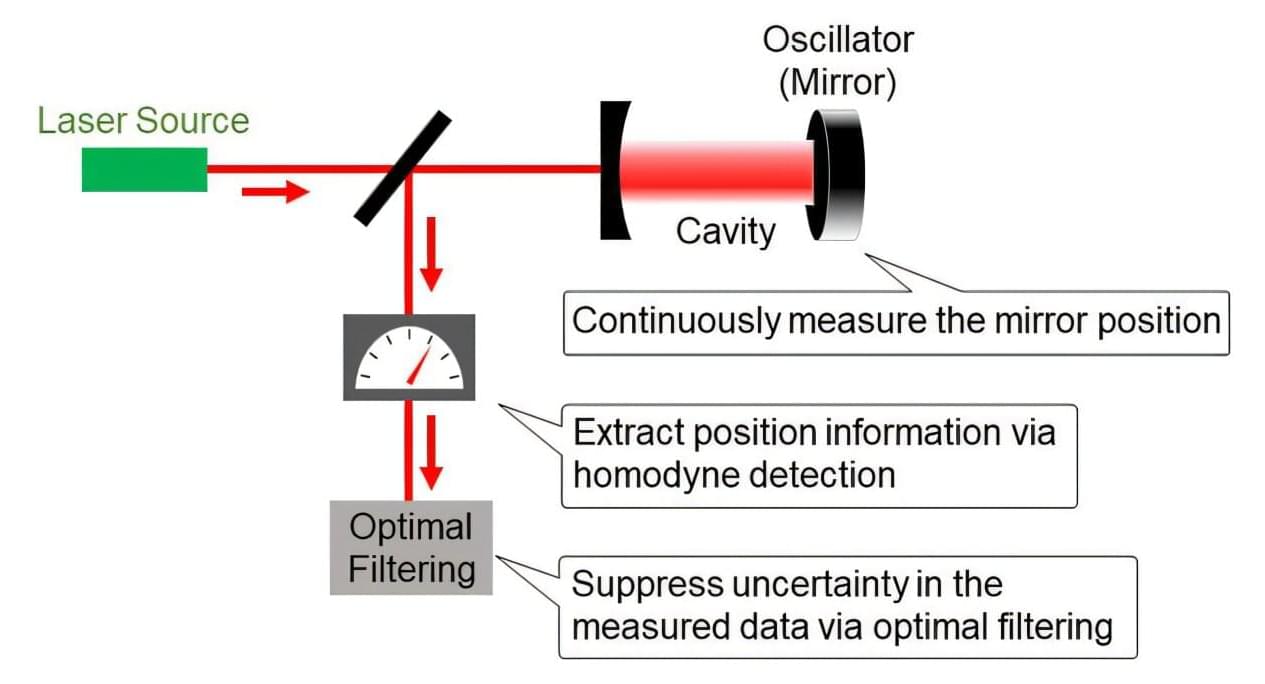
In quantum physics, objects can exist in multiple states at the same time—a phenomenon known as quantum superposition, where a particle does not have a single definite value of position or momentum until it is measured. A major open question is whether gravity, one of the fundamental forces, also follows the quantum rule. One way to examine this is through gravity-induced entanglement, in which two objects that interact only via gravity become quantum mechanically linked.
Now, researchers led by Professor Kazuhiro Yamamoto at the Faculty of Science and Quantum and Spacetime Research Institute, Kyushu University, have proposed a way to enhance the quantum superposition of a mirror’s position in systems in which two mirrors interact via gravity, thereby making the resulting entanglement signal easier to detect. Their findings, published in the journal Physical Review Research on April 13, 2026, represent a crucial step toward experimentally testing whether gravity is fundamentally quantum.
Gravity-induced entanglement suggests that if gravity follows quantum mechanics, then two objects interacting only through gravity should become entangled. This is a natural prediction of the quantum nature of gravity. Detecting this effect, however, is challenging as gravity is weak at small scales.