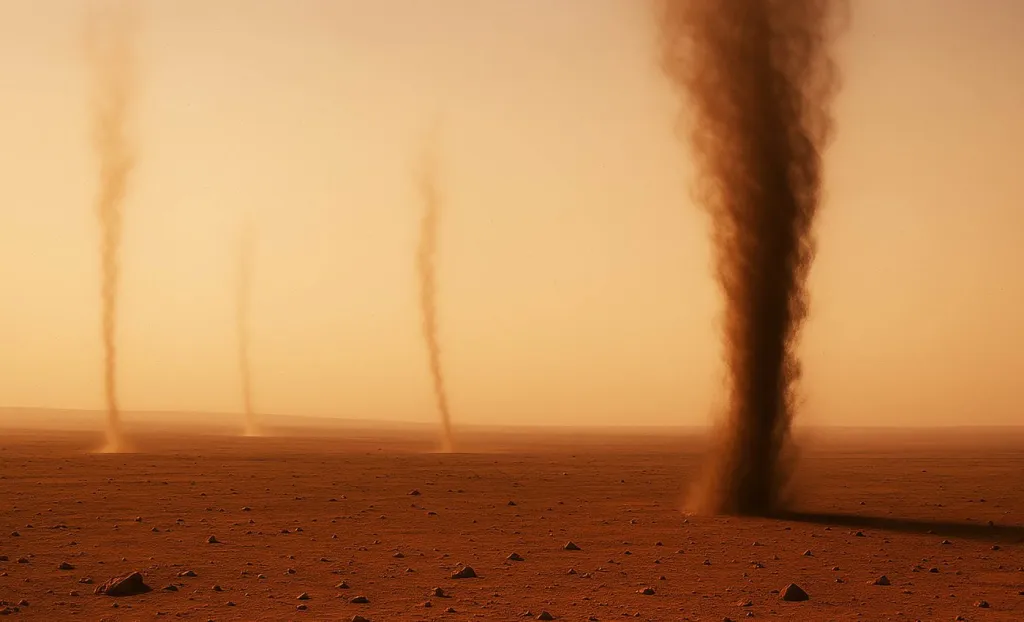
Mars may look like a quiet, dusty world, but it’s actually buzzing with hidden electrical activity. Powerful dust storms and swirling dust devils generate static electricity strong enough to spark faint glowing discharges across the planet, triggering chemical reactions that reshape its surface and atmosphere. Scientists have now shown that these tiny lightning-like events can create a surprising mix of chemicals—including chlorine compounds and carbonates—and even leave behind distinct isotopic “fingerprints.”
Mars is often portrayed as a dry, lifeless desert, but it is far more active than it appears. Its thin atmosphere and dusty terrain create an environment where constant motion generates electrical energy. Dust storms and spinning dust devils sweep across the surface, continually reshaping the landscape and driving processes that scientists are only beginning to fully understand.
Planetary scientist Alian Wang has been studying this phenomenon in depth. In a series of studies, including recent work published in Earth and Planetary Science Letters, she has examined how these electrically charged dust activities influence the chemistry of Mars, particularly through their impact on isotopes.