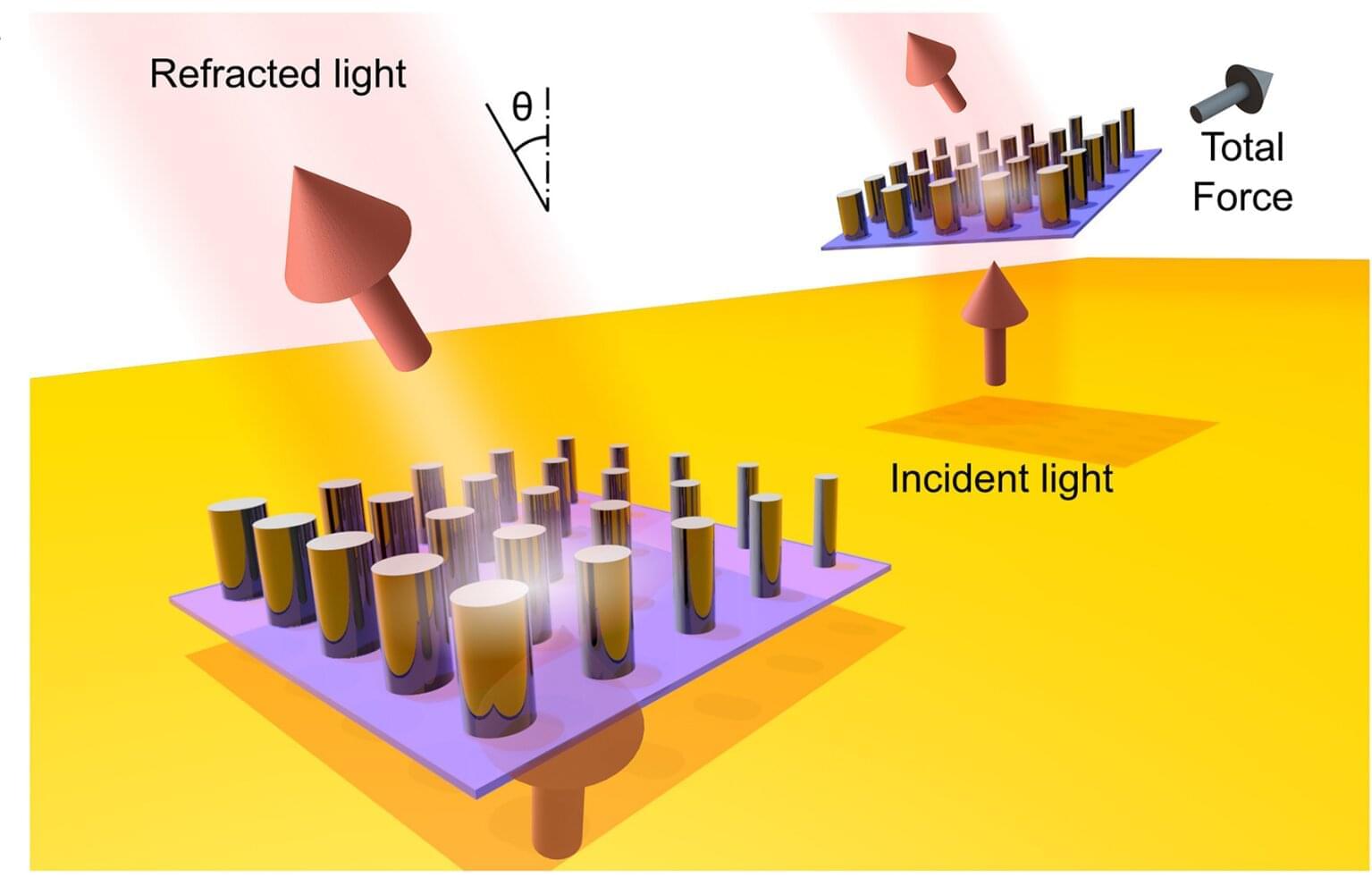
Reaching the nearest star system, Alpha Centauri, would take hundreds of thousands of years using current rocket propulsion technology. Researchers in the J. Mike Walker ‘66 Department of Mechanical Engineering at Texas A&M University have demonstrated a new approach to light-driven motion, showing that lasers can be used to lift and steer objects in multiple directions without physical contact. This breakthrough may one day enable travel to Alpha Centauri within roughly 20 years.
Dr. Shoufeng Lan, assistant professor and director of the Lab for Advanced Nanophotonics, and his team published the work, “Optical propulsion and levitation of metajets,” in Newton. The study introduces micron-scale devices, termed “metajets,” that generate controlled motion when illuminated by laser light.
These metajets are composed of metasurfaces —ultrathin materials engineered with tiny patterns that enable scientists to control how light behaves, much like shaping a lens, but on a much smaller and more precise scale. By carefully designing these structures, the research team controlled how light transfers momentum to an object, enabling it to move.