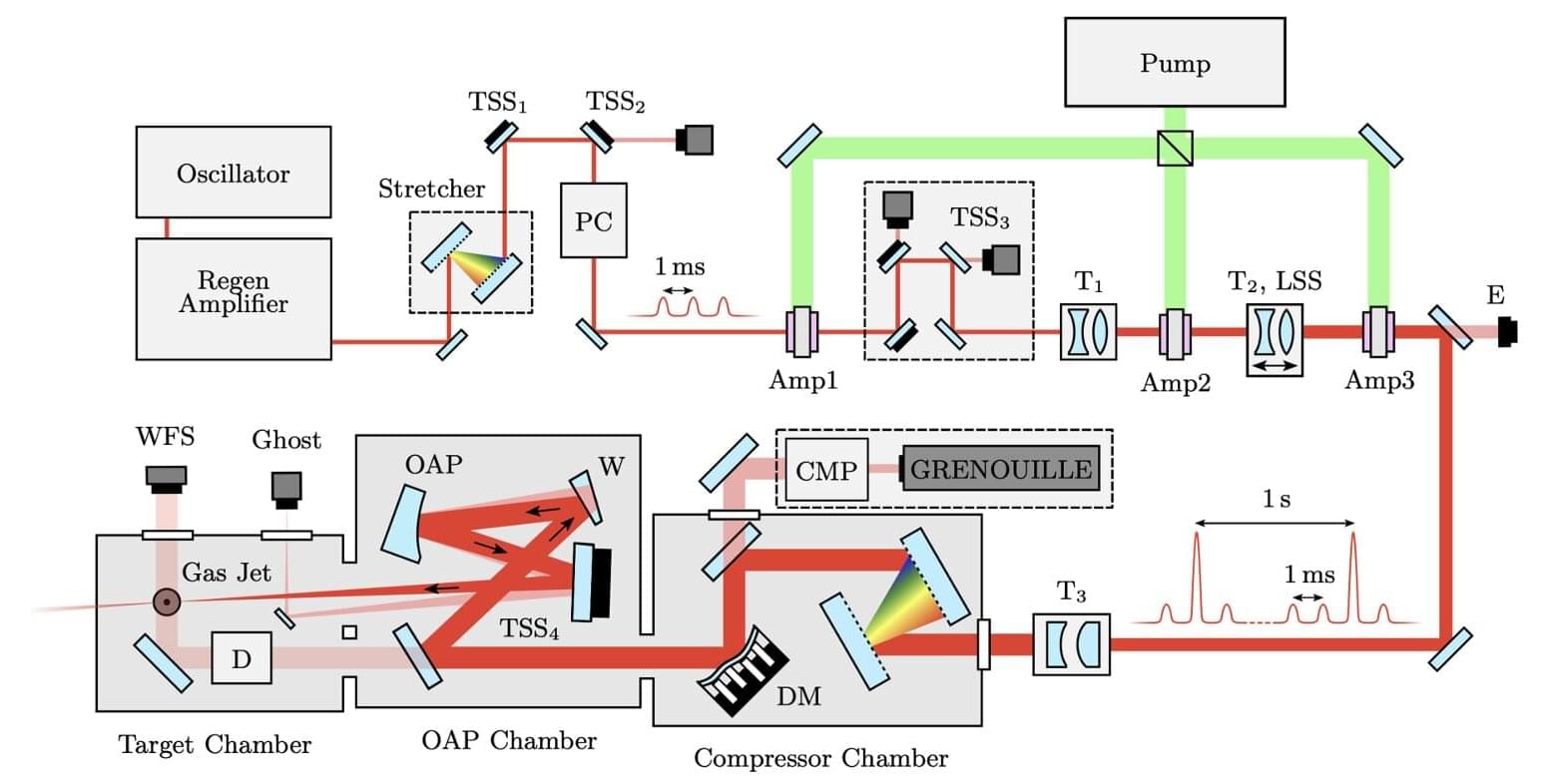
For the first time, researchers have demonstrated that a laser-plasma accelerator can reliably drive a free-electron laser for more than eight hours. Published in Physical Review Accelerators and Beams, the result was achieved by a team led by Finn Kohrell at Lawrence Berkeley National Laboratory, in collaboration with Texas-based company Tau Systems—and could soon make the technology vastly more accessible for a broad range of applications in industry and research.
Free-electron lasers (FELs) generate intense, coherent pulses of light, most often in the ultraviolet to X-ray range. This involves sending high-energy electron bunches through an undulator: a device that alternates a magnetic field to accelerate electrons back and forth, causing them to emit increasingly bright and coherent radiation.
By harnessing this radiation as laser light, researchers can probe matter at the atomic scale and capture ultrafast processes in real time, making it invaluable to a vast array of applications.
There is a very balanced and engaging energy throughout this post, since the ideas are presented with clarity and the tone stays open enough for different readers to connect with the discussion from their own perspective.
https://cleanout-kings.com
This post is a fantastic resource for anyone wanting a reliable overview. The clear explanations and completely unbiased approach make it a pleasure to read, and I will certainly be keeping this page bookmarked for any future reference I might need.
texas online slots
This post feels very carefully structured because the ideas connect naturally and the wording stays simple without losing depth, which helps make the overall discussion more engaging and comfortable to read carefully.
zoo porno