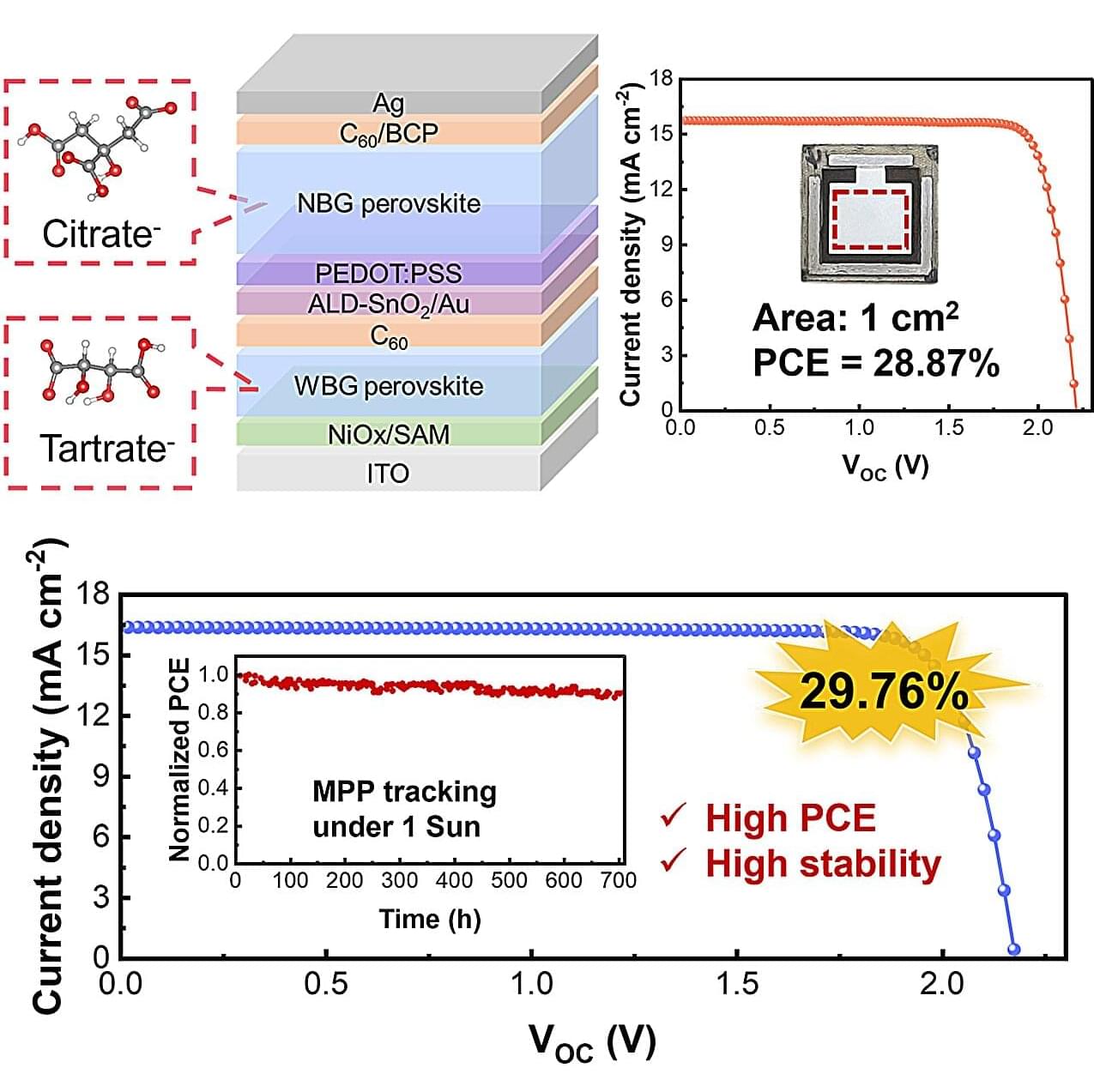
Two stacked layers comprise tandem solar cells (TSCs), with each subcell absorbing different wavelengths of sunlight, which makes TSCs more efficient than single-layer solar cells. All-perovskite TSCs hold great promise for next-generation photovoltaics, with a theoretical efficiency exceeding 40%. However, their practical performance is hampered by mismatched crystallization kinetics between their wide-bandgap (WBG) and narrow-bandgap (NBG) subcells, leading to phase segregation and defect accumulation.
To address this challenge, a research group led by Prof. Ge Ziyi and Prof. Liu Chang from the Ningbo Institute of Materials Technology and Engineering of the Chinese Academy of Sciences has developed an innovative colloidal chemistry strategy to enhance the performance of these TSCs, achieving a power conversion efficiency (PCE) of 29.76%. Their study is published in Joule.
The researchers designed a unified carboxylate-based modulator system using two graded carboxylate anions—tartrate (Ta-) and citrate (Cit-)—to precisely regulate the nucleation dynamics of the two subcells.