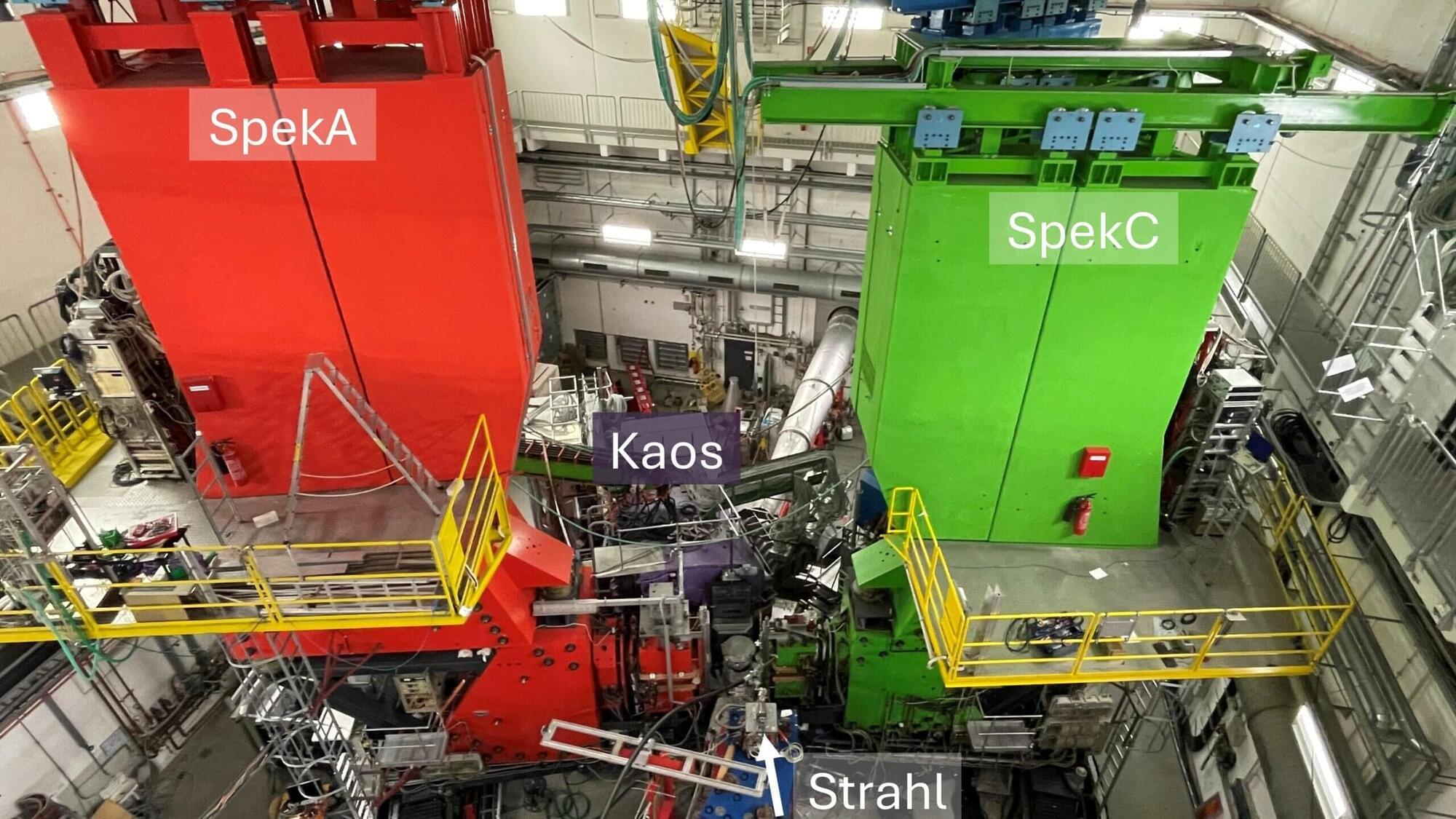
An international research team of the A1 Collaboration at the Mainz Microtron (MAMI) of Johannes Gutenberg University Mainz (JGU) has succeeded in determining the binding energy of the hypertriton with unprecedented precision. This experiment provides crucial new insights into the interaction between hyperons and nucleons—an aspect of the strong nuclear force that has so far remained insufficiently understood. The results show that the hypertriton is significantly more strongly bound than many earlier experiments suggested. The journal Physical Review Letters has recently published the study.
The hypertriton is the lightest known hypernucleus. It is an artificially produced hydrogen isotope that, in addition to a proton and a neutron, contains a so-called Lambda hyperon. Although hypernuclei exist for only a few hundred trillionths of a second, they provide unique insights into the strong interaction—the fundamental force that binds atomic nuclei and underlies the structure of matter in the universe. The hypertriton plays a key role in this context: consisting of only three particles, it is ideally suited for precise tests of theoretical models of the hyperon-nucleon interaction.
“Precisely because the hypertriton has such a simple structure, its properties are highly sensitive to the underlying nuclear forces,” explained Prof. Dr. Patrick Achenbach from the Institute for Nuclear Physics at JGU. “Our new measurement clearly shows that this interaction is stronger than long assumed—an important step toward resolving a puzzle that has persisted for many years.”