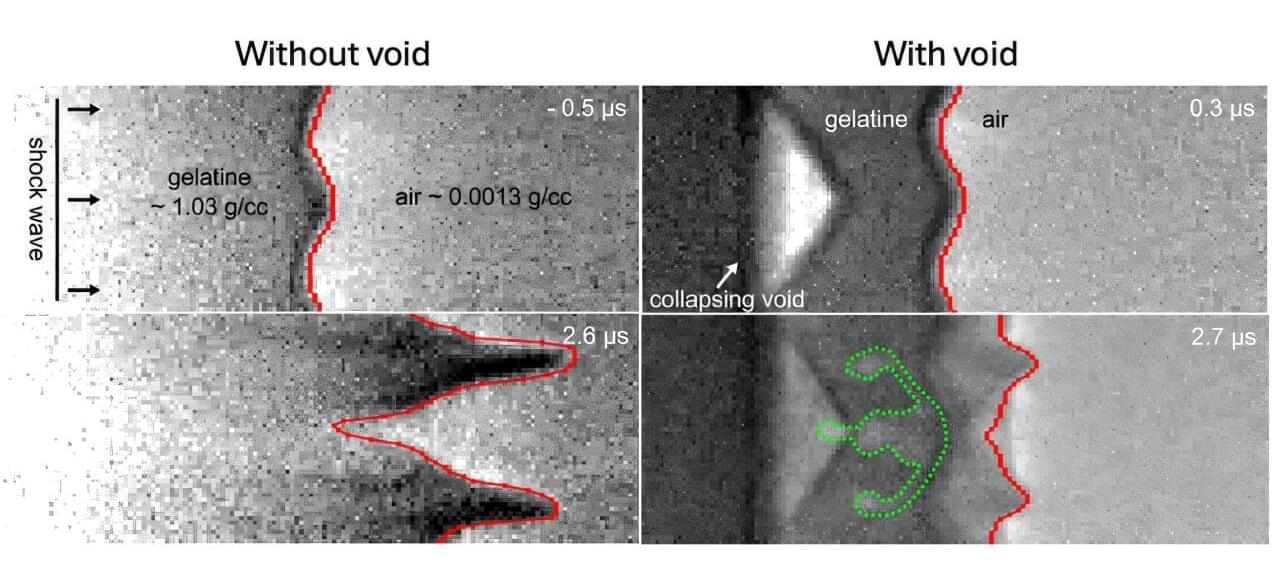
Picture two materials sandwiched together. The boundary between them may appear flat, but, in reality, it is full of tiny bumps and dents. Suddenly, the materials are hit with a shockwave. If that wave hits a bump in the material interface, it slows down. If it hits a dent, it accelerates forward. This imbalance creates fast, narrow jets of material—called the Richtmyer-Meshkov (RM) instability.
In a recent paper, published in Physical Review Letters, researchers from Lawrence Livermore National Laboratory (LLNL), Imperial College London and their collaborators used AI to optimize and 3D printing to create a target that effectively negates the RM instability.
“Our target reshapes the shockwave, in both space and time, as it travels through the material,” said first author Jergus Strucka, now at the European XFEL. “Instead of a single shock hitting the surface, we introduce voids to break it up into a sequence of smaller pressure pulses that arrive at slightly different times.”