A 19th-century theory of elasticity inspires a new way to analyze a quantum phase transition that has become central to modern quantum materials research.
When a crystalline metal enters a so-called nematic state, the onset of strong fluctuations among interacting electrons spontaneously breaks the crystal’s rotational symmetry and distorts both the physical lattice and the notional Fermi surface. This transition, known as nematic criticality, has been observed near the onset of superconductivity in cuprates, pnictides, and twisted bilayer graphene and could hold the key to explaining these poorly understood forms of superconductivity. Now Joe Meese and Rafael Fernandes of the University of Illinois-Champaign have proposed that nematic criticality is more selective in how it breaks rotational symmetry than previously assumed [1, 2]. The selectivity arises not from a novel microscopic mechanism but from a geometric constraint.
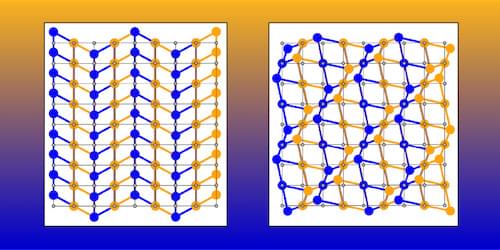
Nematic order typically develops spontaneously upon cooling; hydrostatic pressure can shift the transition, while uniaxial stress can tune the transition or induce nematicity by linearly coupling to lattice strain. Because of this connection, nematic order obeys the same mechanical laws as other continuous lattice deformations do. Consequently, as Meese and Fernandes showed, nematic order splits into two classes. One class is compatible with the lattice and can turn critical; the other is incompatible with the lattice and is therefore suppressed (Fig. 1). In the conventional picture, the energy cost of completing a nematic transition is “softened”—that is, reduced by the emergence of fluctuations as the transition is approached. That condition remains true in Meese and Fernandes’ picture, but the softening is not spread over all the possible distortions allowed by symmetry. Rather, elasticity itself selects the modes that participate in nematic criticality.