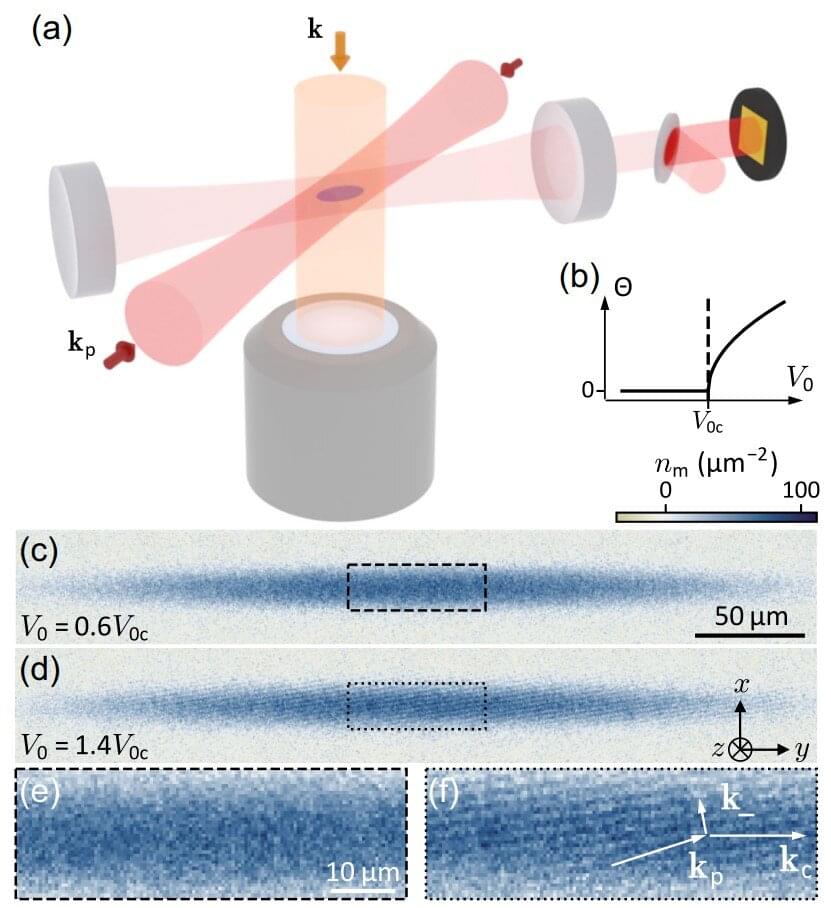
A new study, published in Physical Review Letters, reports that scientists have successfully imaged the formation of cavity-induced density waves induced by laser light in an ultracold quantum gas. Previously, only global signals, such as photon leakage or the peak in energy deposition of a fast charged particle (Bragg peaks), have been used to detect this kind of ordering. Prior to this study, there had been no direct, high-resolution in situ imaging of cavity-induced density-wave order in ultracold gases.
When laser light is arranged so that it bounces back and forth between two mirrors, light waves become trapped and create what is referred to as an optical cavity. This creates standing waves or amplifies light through resonance. When atoms in an ultracold unitary Fermi gas are placed in an optical cavity, they can absorb and emit this light. Unitary Fermi gases exist in a strongly interacting state where the wave scattering length makes interactions independent of the specific atomic details.
Light emitted by atoms in the gas can be absorbed by other atoms. This exchange of photons creates further interactions between the atoms that can cause a self-rearrangement into a periodic pattern within the gas, referred to as a density wave. This self-organization occurs above a critical threshold, called the superradiant phase transition, where the exchange of photons enables simultaneous, collective interaction among all atoms.