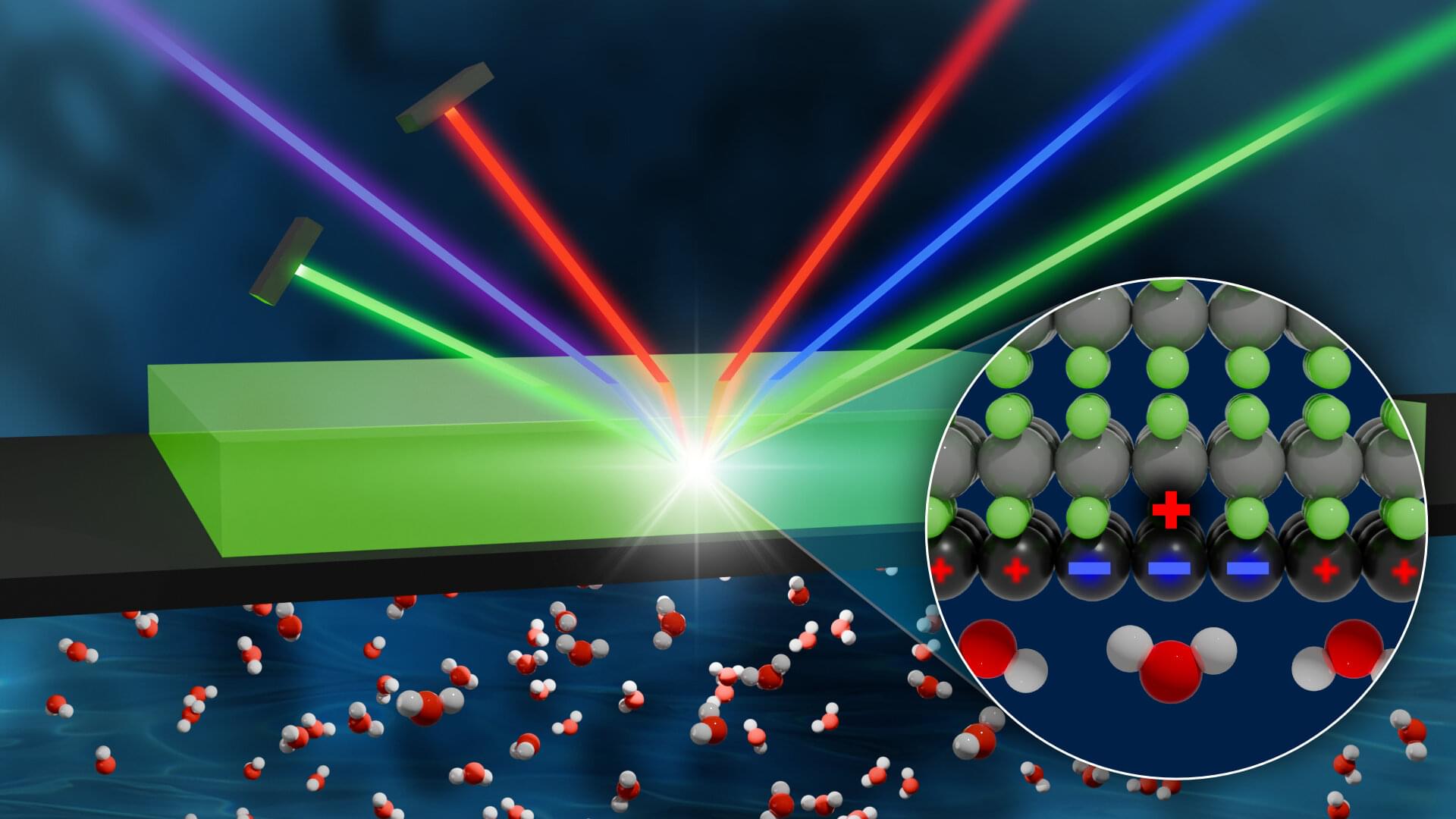
Research on graphene has made great strides in recent years. However, to fully harness its potential in applications such as desalination membranes, sensors, and energy storage and conversion, a deeper understanding of the interaction between graphene and water is required.
Until now, it was widely thought that graphene, when supported on a substrate, largely inherits the wetting properties of the underlying material, a phenomenon known as “wetting transparency.” An international research team led by Yongkang Wang and Yair Litman has now shown that, while graphene appears transparent on large scales, it exerts a subtle but significant influence on nearby water molecules at the nanoscale. The study is published in the journal Chem.
Graphene, a carbon layer just one atom thick, is considered a wonder material: extremely stable, highly conductive, and optically transparent. For a long time, it appeared just as transparent to water: measurements of the water contact angle—a measure of wettability—showed that graphene on a substrate lets through the substrates wettability virtually unchanged. This phenomenon of wetting transparency, observed for years, seemed to contradict the fact that graphene is highly polarizable and therefore reacts sensitively to charges in the substrate.