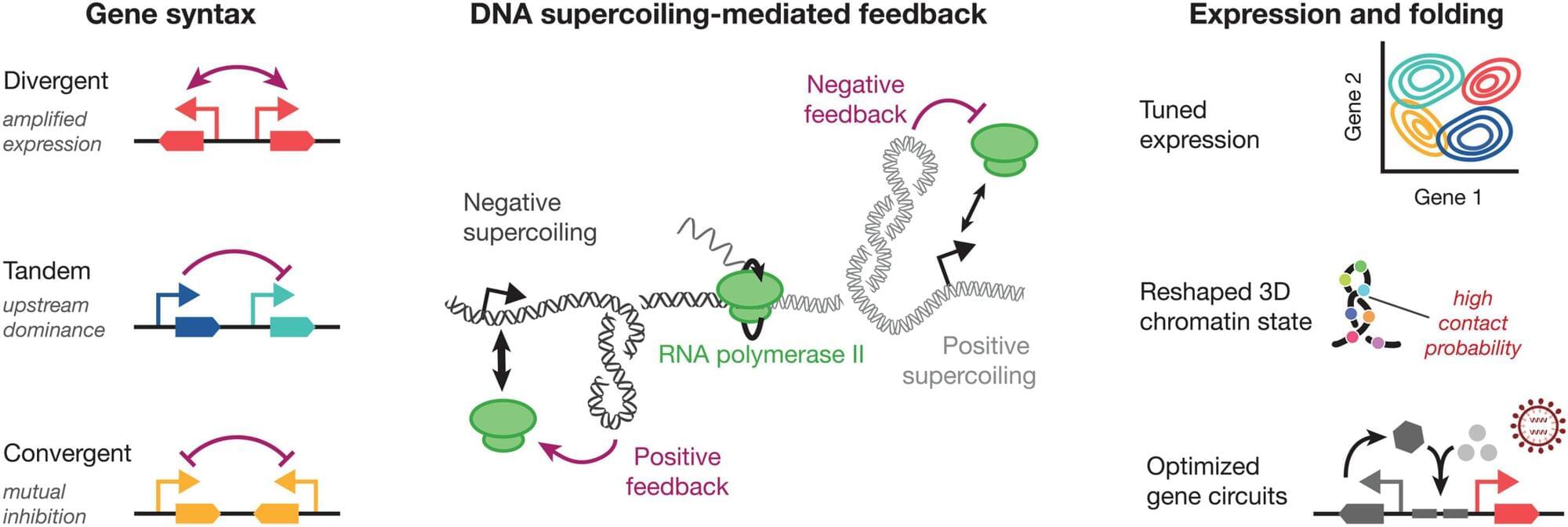
When a gene is turned on in a cell, it creates a ripple effect along the DNA strand, changing the physical structure of the strand. A new study by MIT researchers, appearing in Science, shows that these ripples can stimulate or suppress neighboring genes. These effects, which result from the winding or unwinding of neighboring DNA, are determined by the order of genes along a strand of DNA. Genes upstream of the active gene are usually turned up, while those downstream are inhibited.
The new findings offer guidance that could make it easier to control the output of synthetic gene circuits. By altering the relative ordering and arrangement of genes (gene syntax), researchers could create circuits that synergize to maximize their output, or that alternate the output of two different genes.
“This is really exciting because we can coordinate gene expression in ways that just weren’t possible before,” says Katie Galloway, an assistant professor of chemical engineering at MIT. “Syntax will be really useful for dynamic circuits. Now we have the ability to select not only the biochemistry of circuits, but also the physical design to support dynamics.”