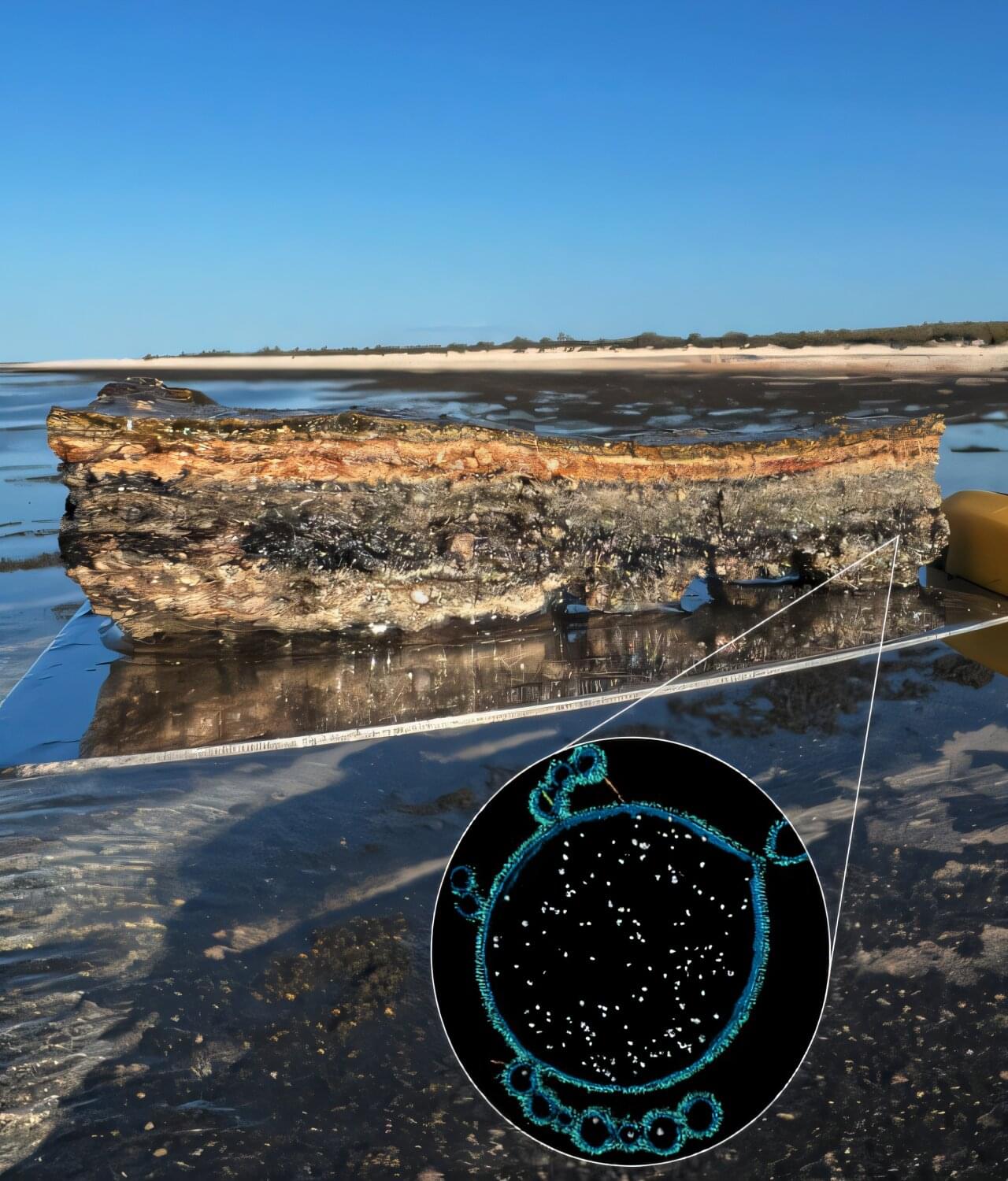
Stromatolites—and their close relatives, microbial mats—could be mistaken for what seems like a bunch of old dark rocks. But instead, they are dense, layered communities of microbes. Long before complex life such as animals or plants existed, stromatolites breathed the first molecules of oxygen into Earth’s atmosphere. Now, in a study published in Current Biology, researchers say they may also hold insights into how complex life began.
Associate Professor Brendan Burns, an evolutionary microbiologist at UNSW Sydney, is part of a team that identified a previously unknown microbe living in close partnership with another organism inside these “living fossils.” The work, co-led with researchers from the University of Technology Sydney and The University of Melbourne, could help solve one of life’s biggest mysteries: how simple cells first combined to form more complex life.
“Stromatolites could be more than ‘just’ a cradle of life where early microbial life flourished,” says A/Prof. Burns.