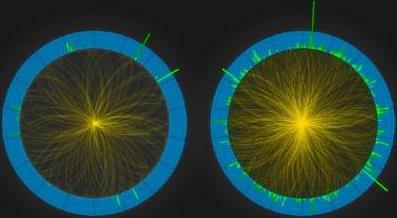
When two heavy nuclei collide at relativistic speeds, the quarks and gluons that are usually bound inside them are briefly liberated, forming an exotic state of matter called quark–gluon plasma. As the quarks and gluons traverse this plasma, they lose energy through scattering, which limits the number of high-momentum particles that reach the detectors. This signature of quark–gluon plasma, called jet quenching, has been definitively observed only in collisions of heavy nuclei such as lead, leaving open the question of how large a nucleus must be to produce quark–gluon plasma. Now the CMS Collaboration at the Large Hadron Collider (LHC) at CERN has observed the first clear evidence of jet quenching in oxygen–oxygen collisions [1].
The LHC collided oxygen nuclei for the first time in 2025. Scientists in the CMS Collaboration measured the rate at which those collisions produced high-momentum daughter particles and compared it to the rate measured for proton–proton collisions at the same collision energy. In the absence of a quark–gluon plasma, the two rates—after accounting for the number of protons and neutrons in the oxygen nuclei—would be approximately equal. The researchers found that, in the oxygen–oxygen collisions, this ratio dipped significantly for daughter particles with energies of around 6 giga-electron-volts (GeV)—a clear indication of the jet-quenching phenomenon.
The oxygen–oxygen collision data recorded by the CMS team are qualitatively similar to those obtained from collisions of larger nuclei such as lead. They are also in better agreement with theoretical models that include quark–gluon energy loss than they are with models that omit it. The result provides the strongest evidence yet that a quark–gluon-plasma-like medium capable of jet quenching can form in collisions of nuclei as light as oxygen.