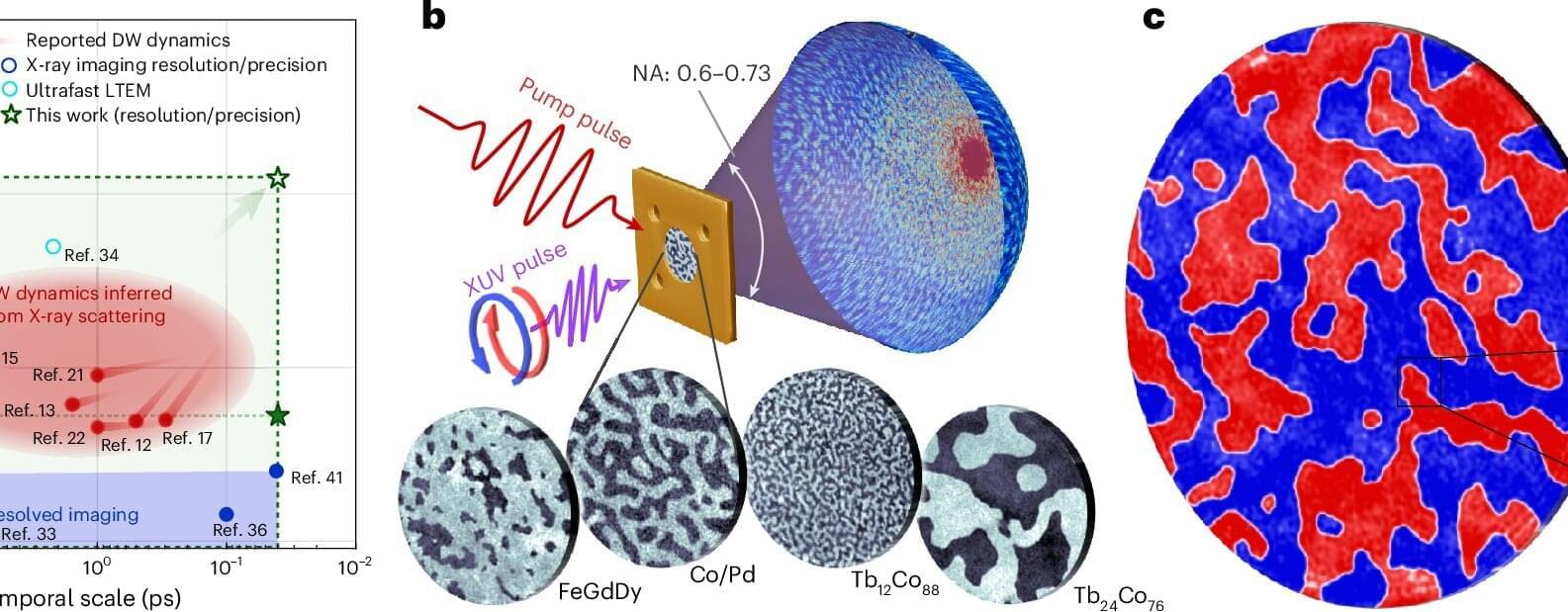
For the first time, researchers have mapped how the boundaries of magnetic nanostructures behave on extremely short timescales. The work of physicist Johan Mentink of Radboud University shows that these boundaries are much more stable than previously thought. This insight will aid the development of future ultra-fast and compact data storage.
Every magnet consists of tiny magnets, known as spins. When a material is magnetic, these spins all point in the same direction. Using ultra-short laser pulses, the spins in magnetic materials can change direction in a very short time. This so-called ultrafast nanomagnetism is important for, for example, hard drives, on which information is stored using magnetic bits. To make this storage faster and smaller, it is essential to understand exactly what happens at the nanoscale.
Using a new imaging technique capable of tracking processes down to the nanometer and femtosecond scale, Mentink and colleagues have researched the behavior of domain boundaries—thin walls of about 1 nanometer that separate magnetic domains. Multiple spins pointing in the same direction form a domain.