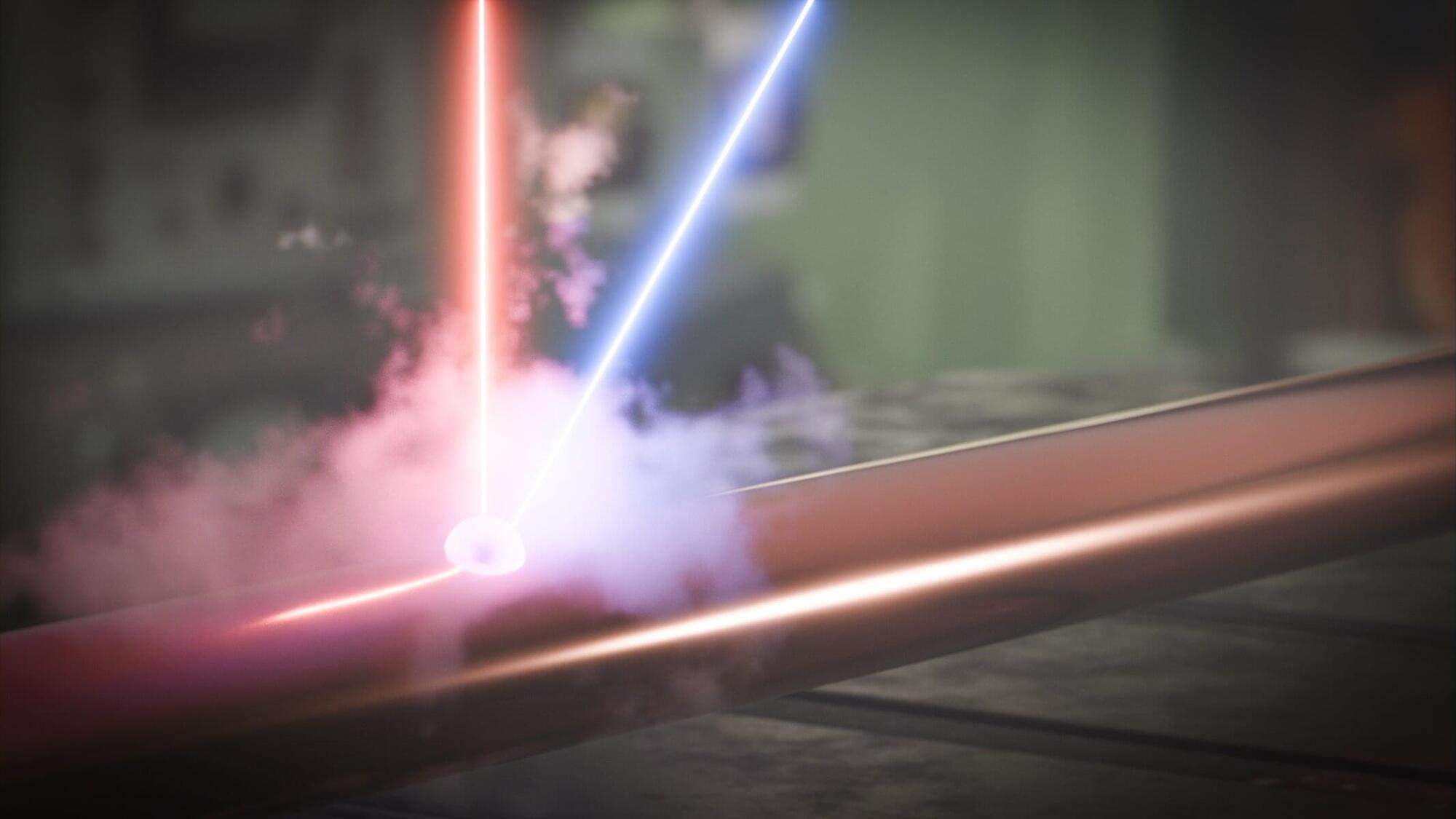
When laser flashes hit matter, electrons are knocked off their orbits around the atomic nuclei. This can generate extremely hot plasmas composed of charged particles—ions and electrons. Researchers at HZDR have now observed this ionization process in more detail than ever before. To do so, they combined two state-of-the-art lasers: the X-ray free-electron laser and the high-intensity optical laser ReLaX at the HED-HiBEF experiment station at the European XFEL in Schenefeld, near Hamburg. Their findings, published in Nature Communications, deliver fundamental insights into the interaction of high-energy lasers and matter under extreme conditions.
Ionization takes place extremely quickly—in picoseconds, within a few trillionths of seconds. In order to monitor this process in detail, laser pulses must be significantly shorter. “These are exactly the conditions provided by the two lasers that have pulse durations of just 25 and 30 femtoseconds—that is, trillionths of a second,” explains Dr. Lingen Huang, head of experimentation in HZDR’s Division of High-Energy Density.
Initially, an extremely intense flash of light strikes a delicate copper wire that is only about one-seventh the thickness of a human hair. The pulse intensity is approximately 250 trillion megawatts per square centimeter—concentrated on a tiny surface for an extremely short time. Values like this are otherwise achieved only under exceptional conditions, such as in extreme astrophysical environments like the immediate vicinity of neutron stars or during gamma-ray bursts.
Thank you for taking the time to put this comprehensive overview together, as it really helps clarify a lot of the questions I had regarding this topic and provides a solid foundation for further exploration.
https://planetzilcho.com