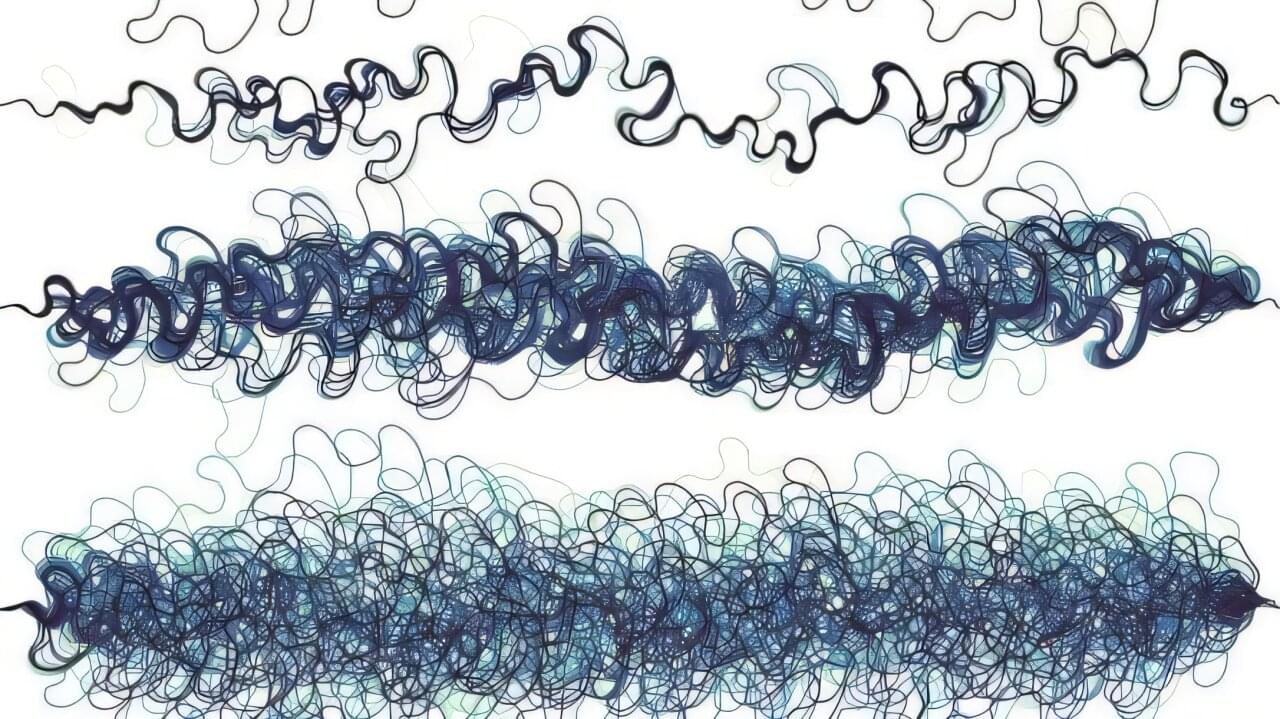
Rivers are rarely the calm, orderly streams we imagine on maps. Over time, their winding paths—called meanders—shift, bend, and occasionally snap off in sudden “cutoff” events that shorten loops and reshape the landscape. While scientists have long suspected that such cutoffs inject a dose of unpredictability into river evolution, a new study published in Communications Earth & Environment demonstrates that these abrupt events are, by themselves, enough to produce chaos in river channels.
Harvard Ph.D. candidate Brayden Noh and NYU Tandon Assistant Professor Omar Wani used a widely used computational model to explore how meandering rivers evolve over time. This model isolates the essential dynamics: bends migrate laterally in proportion to curvature, and loops are occasionally severed through cutoffs. Other real-world complexities—like sediment transport, bank composition, and vegetation—are treated as secondary, allowing the researchers to focus squarely on the geometry-driven behavior of rivers.
To test the role of cutoffs, the team simulated rivers starting from nearly identical initial shapes, then introduced infinitesimally small perturbations to each of the multiple copies. They tracked how the channels diverged over time by mapping their evolving shapes onto a fixed grid and measuring differences cell by cell. In a striking counterfactual experiment, when cutoffs were disabled, the two channels stayed nearly identical over large time horizons. When cutoffs were allowed, even tiny initial differences grew exponentially, a hallmark of deterministic chaos.