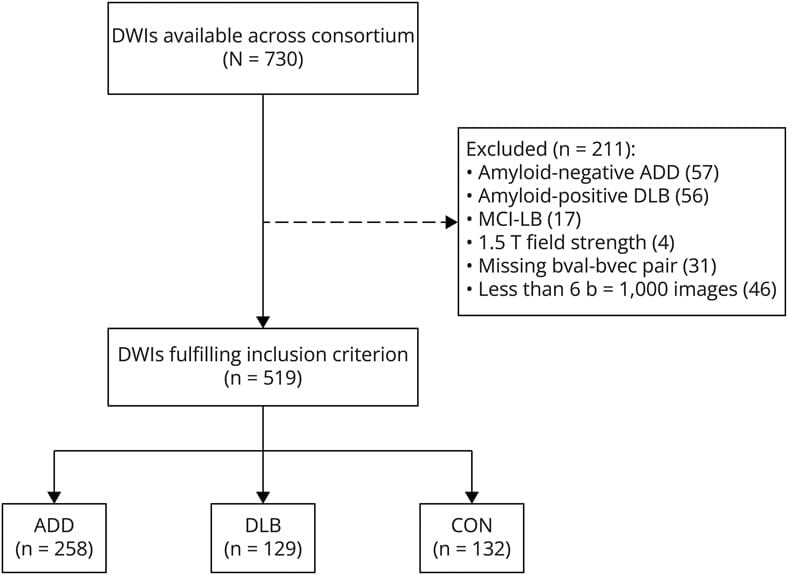
Two most common causes of dementia in older adults are Alzheimer disease dementia (ADD) and dementia with Lewy bodies (DLB).1,2 Differentiating between ADD and DLB in the clinical environment remains challenging with high rates of misdiagnosis using the current standard of care.2 Up to 50% of neuropathologically confirmed DLB, known as Lewy body disease (LBD), are correctly diagnosed antemortem, with ADD as the most common misdiagnosis.2,3 Distinguishing DLB from ADD is a vital part of patient care as DLB has a worse prognosis and requires different treatment plans compared with ADD.4 Patients with DLB are particularly sensitive to neuroleptics prescribed in dementia care, leading to worsening cognitive and motor functions.5 Further, new disease-modifying therapies are approved for ADD, but not for DLB.6,7
The National Institute on Aging and Alzheimer’s Association developed a research framework for Alzheimer disease (AD) classification using biomarkers such as amyloid, tau, and neurodegeneration.8 Amyloid positivity, as assessed using PET or biofluid assays (e.g., AB42/40, ptau217), is a core pathologic, distinguishing feature of AD. However, amyloid and Lewy body copathologies occur in over 50% of patients with LBD and can contribute to diagnostic uncertainty.2,9,10 In lieu of a DLB biomarker classification framework, current diagnostic criteria recommend combining indicative and supportive biomarkers to improve distinguishing between DLB and ADD. Indicative biomarkers include dopamine transporter scans (DaTscan), myocardial scintigraphy, and polysomnography. Supportive biomarkers are collected using MRI, PET, or SPECT scans, and EEG. Current MRI biomarkers in DLB leverage the relative sparing of the medial temporal lobe (MTL) to aid in differentiation.