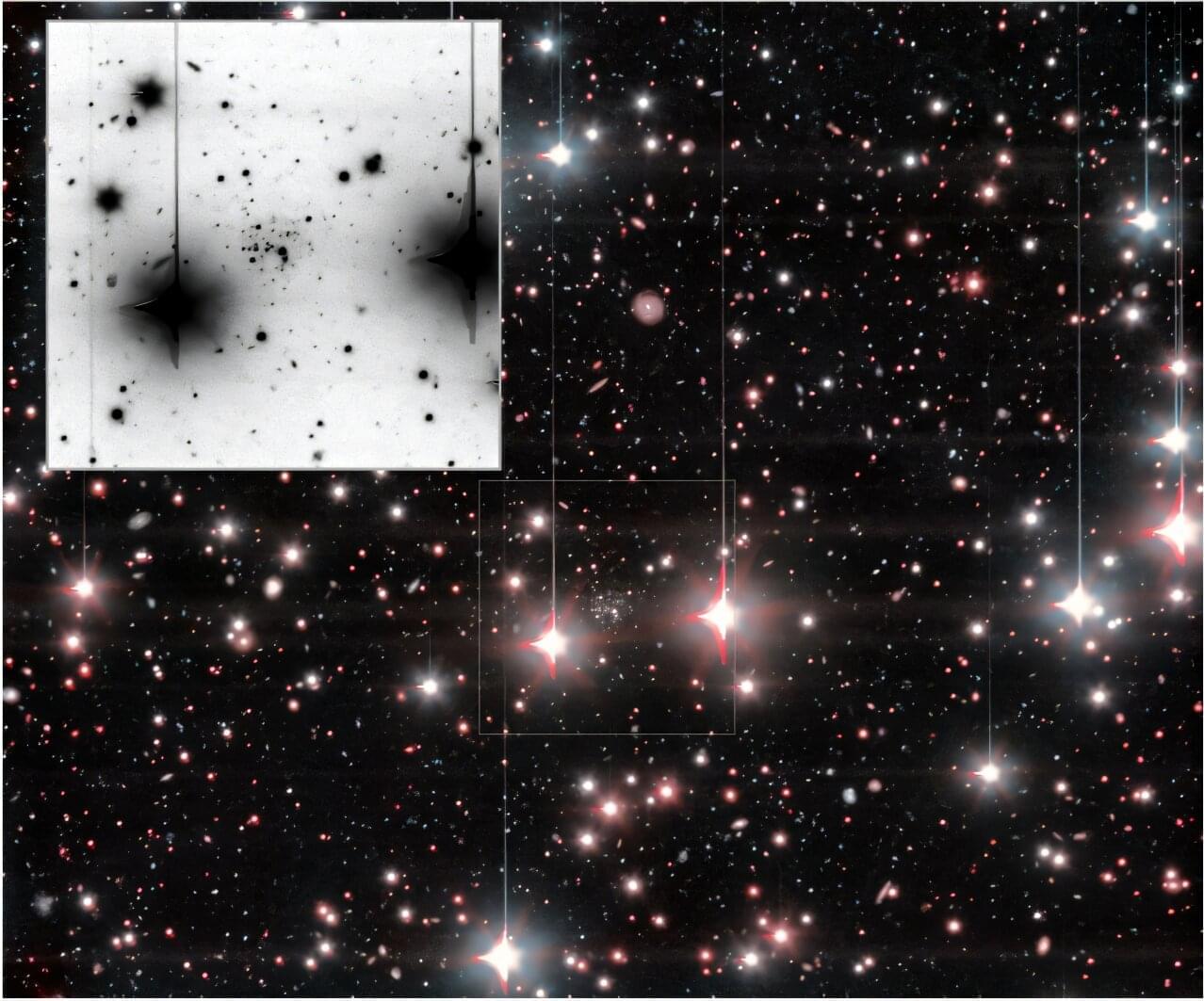
By analyzing the data from the Pan-Andromeda Archaeological Survey (PandAS), European astronomers have discovered a new satellite of the Andromeda galaxy. The newfound object, which received the designation Andromeda XXXVI, appears to be an ultra-faint dwarf galaxy. The finding is reported in a paper published March 30 on the arXiv preprint server.
The so-called ultra-faint dwarf galaxies (UFDs) are the least luminous, most dark matter-dominated, and least chemically evolved galaxies known. Therefore, they are perceived by astronomers as the best candidate fossils from the universe at its early stages.
Now, a team of astronomers, led by Joanna D. Sakowska of the Institute of Astrophysics of Andalusia in Spain, reports the finding of a new UFD. Andromeda XXXVI was first spotted and classified as a candidate UFD by amateur astronomer Giuseppe Donatiello during a systematic, visual inspection search of public images from the full PAndAS footprint. Sakowska and her colleagues recently performed follow-up deep imaging of Andromeda XXXVI with the Roque de los Muchachos Observatory, which confirmed the UFD nature of this galaxy.