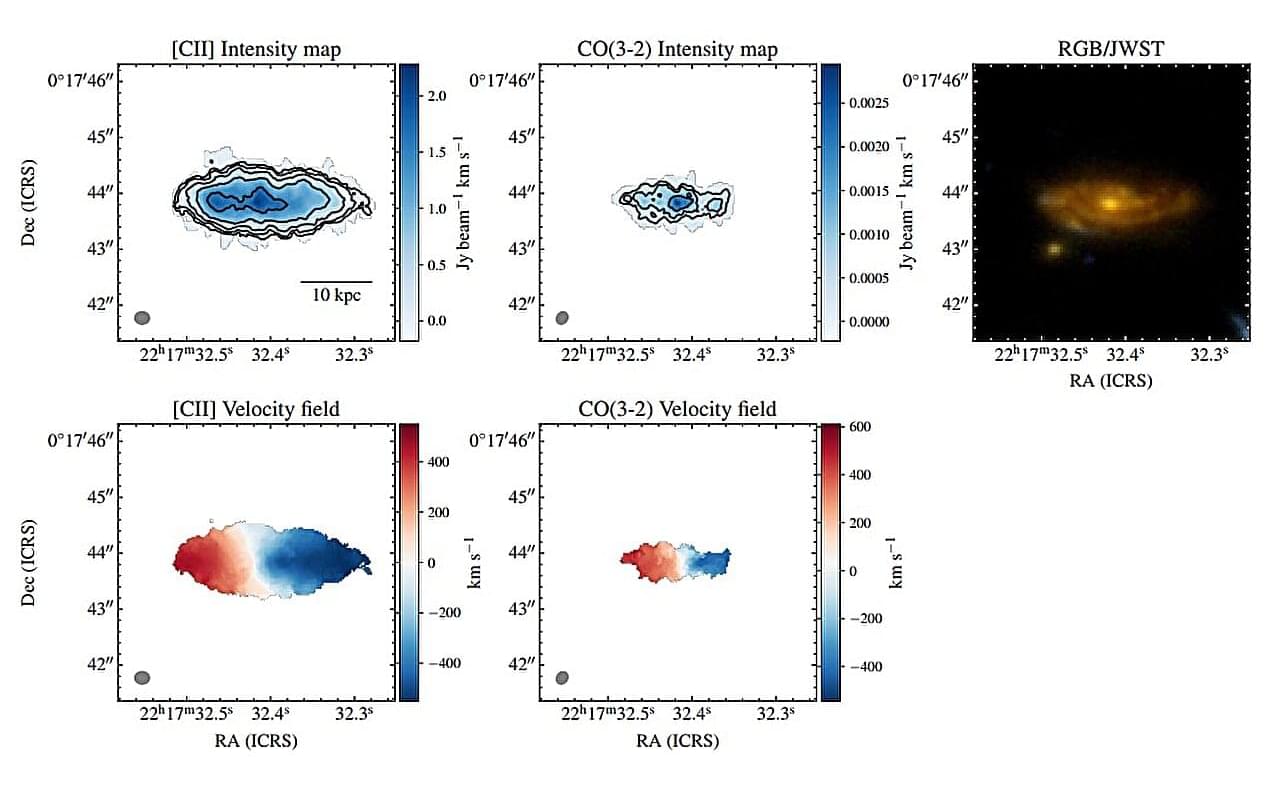
European astronomers have used the Atacama Large Millimeter Array (ALMA) and the James Webb Space Telescope (JWST) to observe a recently discovered giant disk galaxy known as ADF22.1. Results of the new observations, published April 8 on the arXiv preprint server, shed more light on the formation and evolution of this galaxy.
ADF22.1, also known as ADF22.A1, is a giant disk barred spiral galaxy residing in a proto-cluster known as SSA22 at a redshift of 3.09. It has an effective radius of some 22,800 light years and a stellar mass of about 100 billion solar masses. Previous observations have found that it is a dusty star-forming galaxy (DSFG) hosting an intrinsically bright yet heavily obscured active galactic nucleus (AGN).
Giant disk galaxies with high stellar masses, like ADF22.1, are generally expected to be quiescent, bulge-dominated systems. Given that ADF22.1 is a starburst galaxy, it is perceived by astronomers as a unique laboratory to explore how early universe galaxies and supermassive black holes (SMBHs) accumulate their mass and ultimately evolve into the most massive elliptical galaxies.