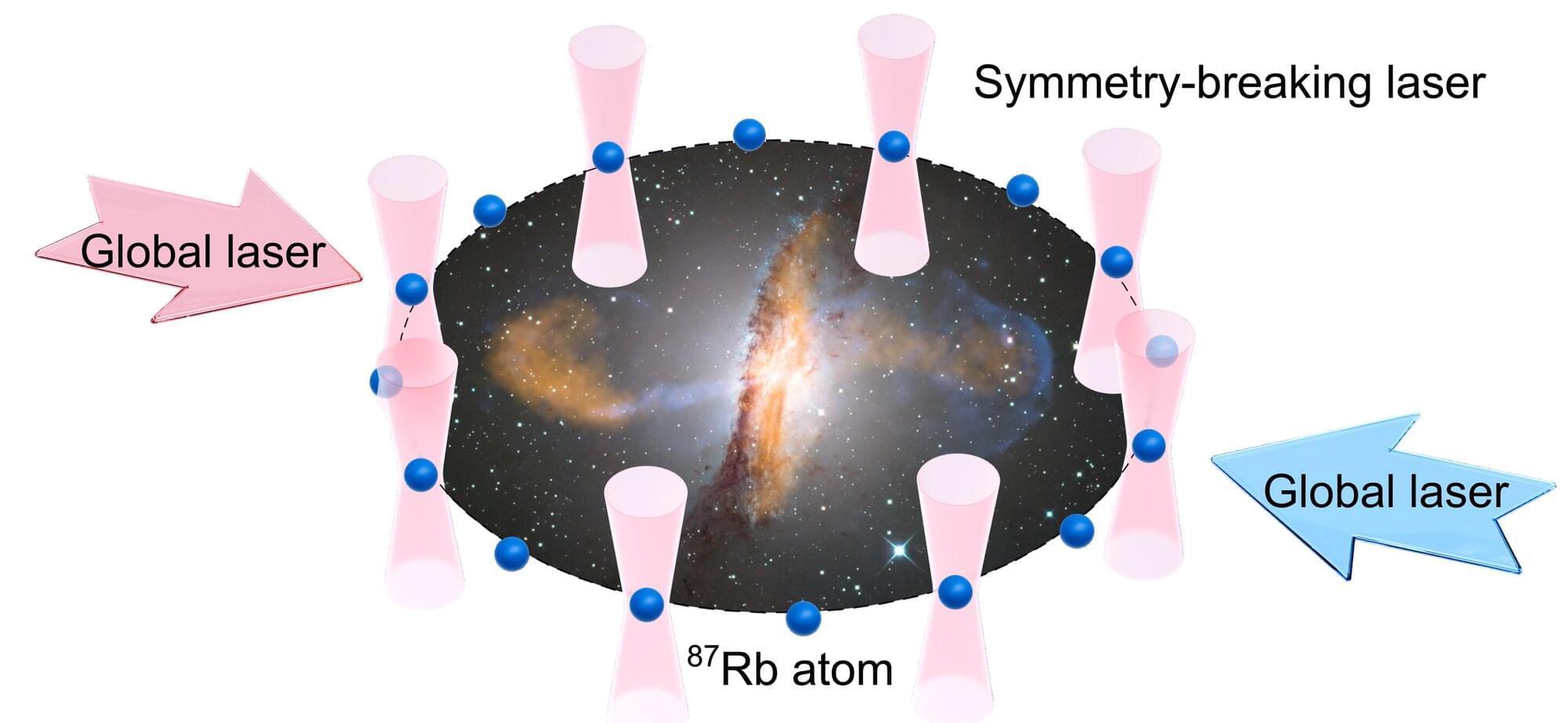
Physicists in China have simulated the effect of “false vacuum decay”: a phenomenon believed to play out constantly in the seemingly empty expanses of space, and which one theory even suggests could bring an abrupt end to the entire universe. In a paper published in Physical Review Letters, Yu-Xin Chao and colleagues at Tsinghua University, Beijing, mimicked the effect using a simple tabletop experiment.
For now, quantum field theory is our most accurate framework for fundamental physics below the scale at which gravity becomes important. It predicts that there is no such thing as a perfect vacuum: while a given space may appear entirely empty, the theory suggests that it is actually just the lowest-energy state of a continuous quantum field.
Since a quantum field can possess multiple local minima energy, this means that a seemingly stable local ground state may not be the most stable state possible for the field as a whole—it is simply separated from a lower-energy, more stable state by an energy barrier, much as a valley may be separated from a deeper valley by a high mountain ridge.