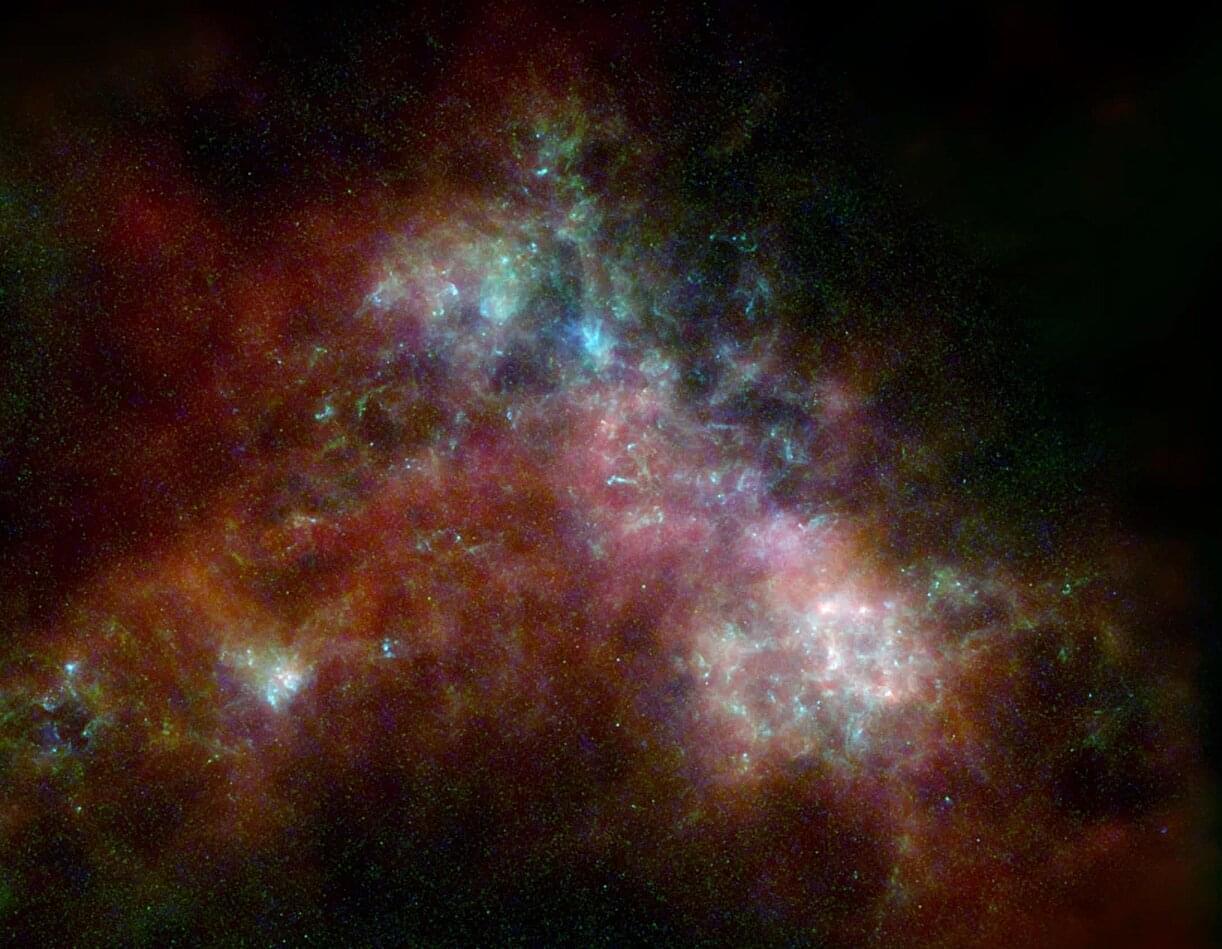
The Small Magellanic Cloud (SMC) is one of the Milky Way’s closest galactic neighbors—a small, gas-rich galaxy visible to the naked eye from the southern hemisphere, and bound to our galaxy by gravity, alongside its companion, the Large Magellanic Cloud (1¹LMC). All three galaxies have been interacting for hundreds of millions of years.
The SMC is also one of the most studied galaxies in the sky. Astronomers have catalogued its stars, mapped its gas and tracked its motion for more than half a century. Yet a basic question about it has remained. The galaxy’s stars do not orbit around its center the way stars in most galaxies do, and it has been challenging to explain why.
Collision reveals a galaxy in flux In a study published in The Astrophysical Journal, University of Arizona astronomers have traced the lack of rotation in stars to a direct collision between the SMC and its larger companion, the LMC. The findings also raise questions about how scientists use the SMC as a reference point for understanding galaxies across the history of the universe.