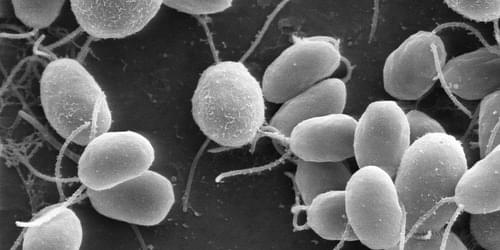
Measurements of the 3D fluid flow around a swimming microorganism could help researchers better understand the swimming dynamics of such microbes.
Swimming microorganisms set up complex fluid flows that affect their ability to feed and communicate. Using advanced holographic methods, researchers have now imaged the entire 3D flow field around a swimming alga, revealing vortex rings that help propel the organism [1]. The researchers hope that the experiments will lead to improvements in measuring the energy expenditure and swimming strategies of a wide range of microorganisms.
The single-cell alga Chlamydomonas reinhardtii swims in a “breaststroke” style by beating its flagella—two hair-like appendages located at the front of its body—cycling 50 times per second. The flagella propel the organism forward while creating a surrounding fluid flow field that influences nutrient uptake and allows the organism to detect predators or mates. “The flow field generated by a swimming microorganism is one of its most fundamental characteristics,” says Xiang Cheng of the University of Minnesota. But he says that previous experiments have only captured partial details of this field, such as vortices to the left and right of the swimming organism. Researchers have speculated that these vortices might be connected in a larger coherent 3D flow pattern, but experiments have been unable to resolve such structures.