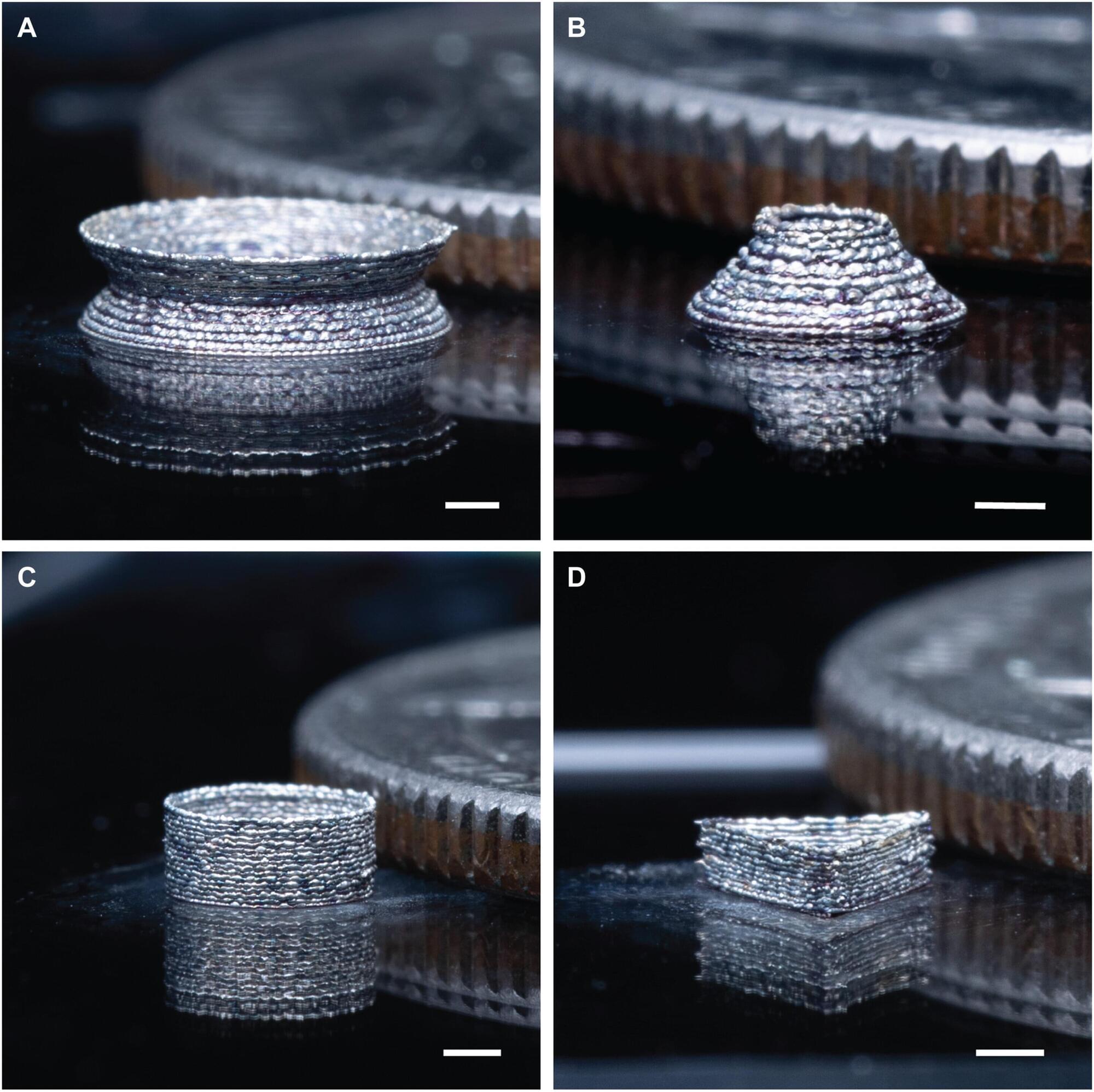
In a recently published paper in Science Advances, a team led by Rice University’s Yong Lin Kong describes a new 3D-printing process with focused microwaves that overcomes a fundamental constraint of electronics 3D printing that has limited the field’s potential for more than a decade: the inability to heat printed ink—a crucial processing step—without damaging the materials underneath.
The ability to integrate functional materials and spatially program their properties governs both device performance and the limits of what can be built. Existing manufacturing approaches are fundamentally limited in both respects. Electronic components, for instance, are fabricated in massive, centralized foundries, often decoupled from the final device. Integrating them requires complex, labor-intensive assembly that constrains both the form and the function of what can ultimately be created.
Multimaterial 3D printing should, in principle, allow fabrication of free-form architectures in which electronic and mechanical properties are programmed directly into the structure. However, the thermal processing required to render printed electronic inks functional destroys the very materials these devices require.
This post has a easy flow that keeps the content interesting while also making the discussion clear and accessible.
https://dobivolki276523.com
I like how this post presents the ideas in a smooth way that feels both meaningful and comfortable to read online.
https://flyingfishci.com