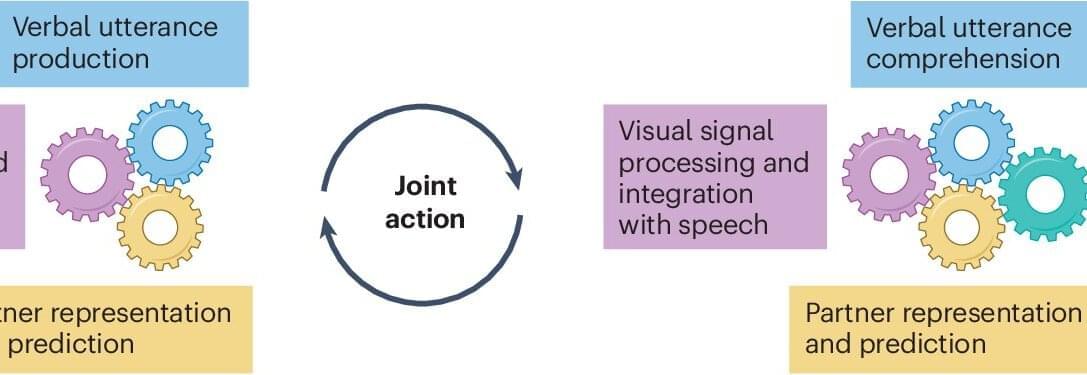
Think about the last time you told a story to a friend. You probably adjusted it halfway through. You saw their eyebrows lift. You noticed them lean in, or glance away. You clarified a detail. You sped up the ending. That constant fine-tuning is not a bonus feature of communication: it is communication. And you can read all about this real-time coordination process in a new review by Judith Holler and Anna K. Kuhlen (Max Planck Institute for Psycholinguistics), published in Nature Reviews Psychology.
Holler and Kuhlen argue that conversation is not simply one person speaking while another listens. It is a process in which both participants continuously monitor, predict, and shape each other’s behavior. “Conversation is not a linear exchange of words,” Holler writes. “It is a jointly managed activity in which meaning emerges through coordination.”