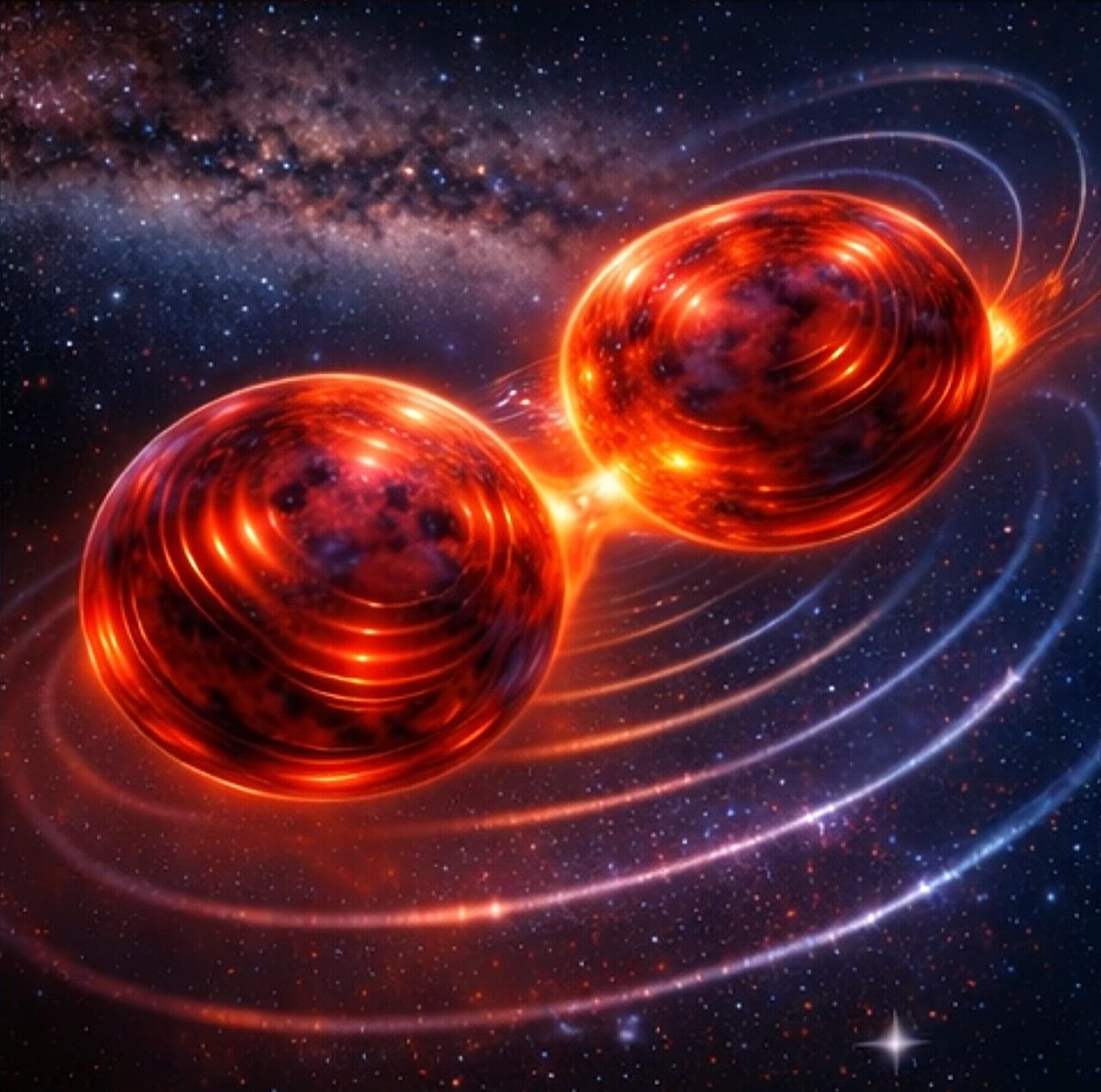
Neutron stars harbor some of the most extreme environments in the universe: their densities soar to several times those of atomic nuclei, and they possess some of the strongest gravitational fields of any known objects, surpassed only by black holes. First observed in the 1960s, much of the internal composition of neutron stars is still unknown. Scientists are beginning to look to gravitational waves emitted by binary neutron‐star inspirals—pairs of mutually orbiting neutron stars—as possible sources of information about their interiors.
Physicists at the University of Illinois Urbana-Champaign, together with colleagues at the University of California, Santa Barbara, Montana State University, and the Tata Institute of Fundamental Research in India have made a major theoretical breakthrough in understanding how inspiraling binary neutron stars respond to tidal forces, a key step in elucidating neutron stars’ makeup. The team has proven that the time‐dependent tidal responses of such stars can be described in terms of their oscillatory behavior, or modes, extending an analogous result from Newtonian gravity to the relativistic setting.
This research was published as an Editors’ Suggestion in the journal Physical Review Letters on February 18, 2026, and paves the way to probing the internal structure of neutron stars and some of nature’s most extreme types of matter using gravitational waves.