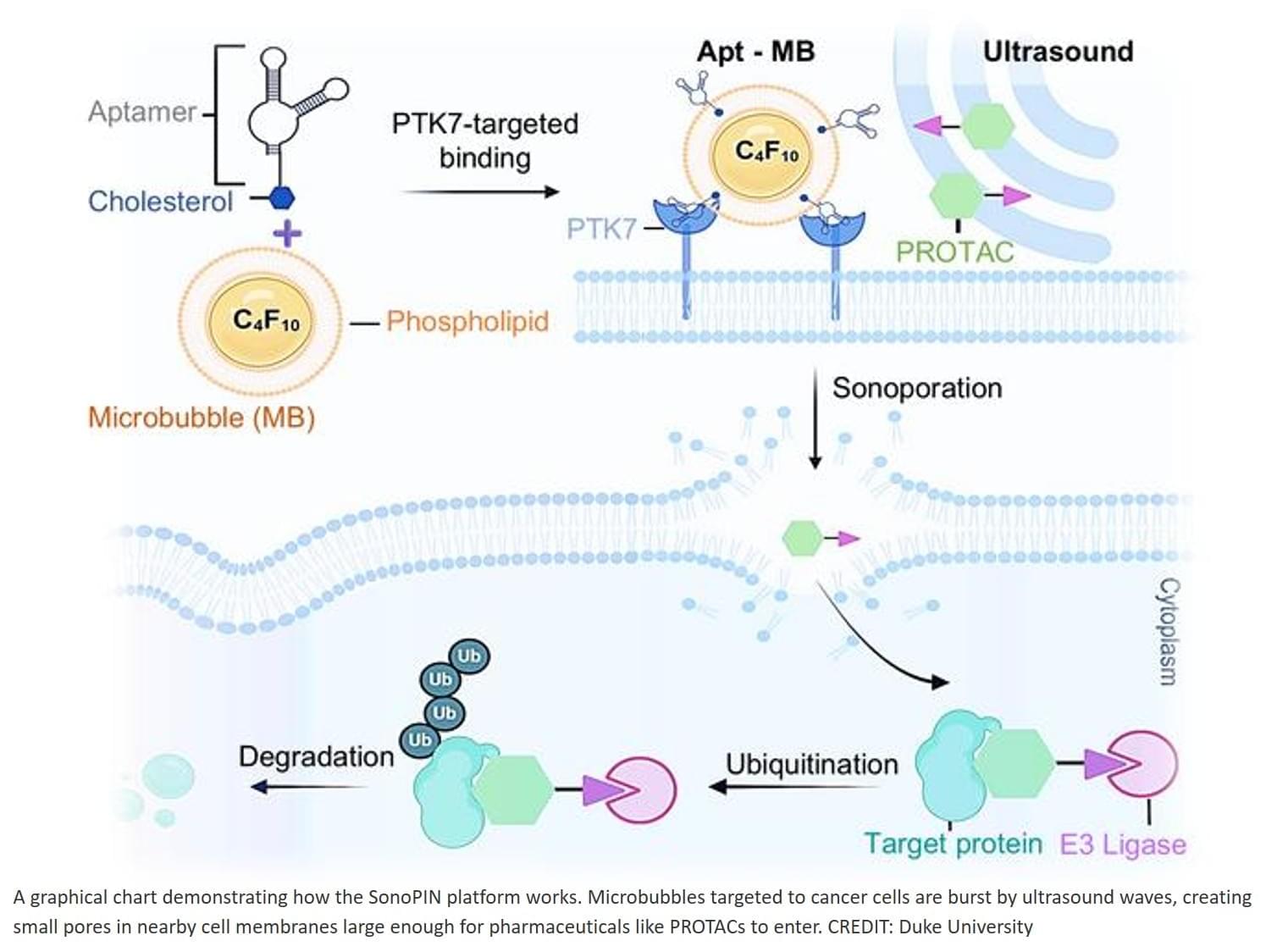
In the study, the authors equipped these microbubbles with synthetic nucleic acid strands designed to bind with specific biochemical receptors that appear on the cell membranes of cancer cells but not healthy cells. They then tried several combinations of ultrasound frequencies and intensities to find the perfect pairing for opening pores in the cell membranes to allow the PROTACs to enter.
Once the optimal settings were identified, the researchers validated the platform by attaching fluorescent molecules to the PROTACs. They conducted separate experiments on cancer cells and healthy cells to compare the delivery efficiency. After a minute of ultrasound exposure, the cells treated with SonoPIN glowed seven times brighter than those treated with traditional PROTAC delivery methods, indicating that they were taking in many PROTACs. This resulted in half of the cancer cells self-destructing, while 99% of the healthy cells remained viable.
Moving forward, the researchers plan to test this approach in mouse models and have already applied for a patent covering the work. By injecting the PROTACs and cancer-seeking microbubbles into their veins and focusing the ultrasound waves on tumor locations, they believe SonoPIN could form a highly potent cancer-killing technology with few side effects. sciencenewshighlights ScienceMission.
Engineers have demonstrated a technique that uses microbubbles and ultrasound to help relatively large cancer drugs enter tumor cells and cause them to self-destruct.
Dubbed “Sonoporation-assisted Precise Intracellular Nanodelivery”—or SonoPIN for short—the technology caused 50% of targeted cancer cells in a benchtop experiment to self-destruct, while leaving 99% of non-targeted cells healthy. The results show promise for precisely delivering a wide variety of large-molecule therapeutics to cells with few off-target effects.
The research appears in the journal Proceedings of the National Academy of Sciences.