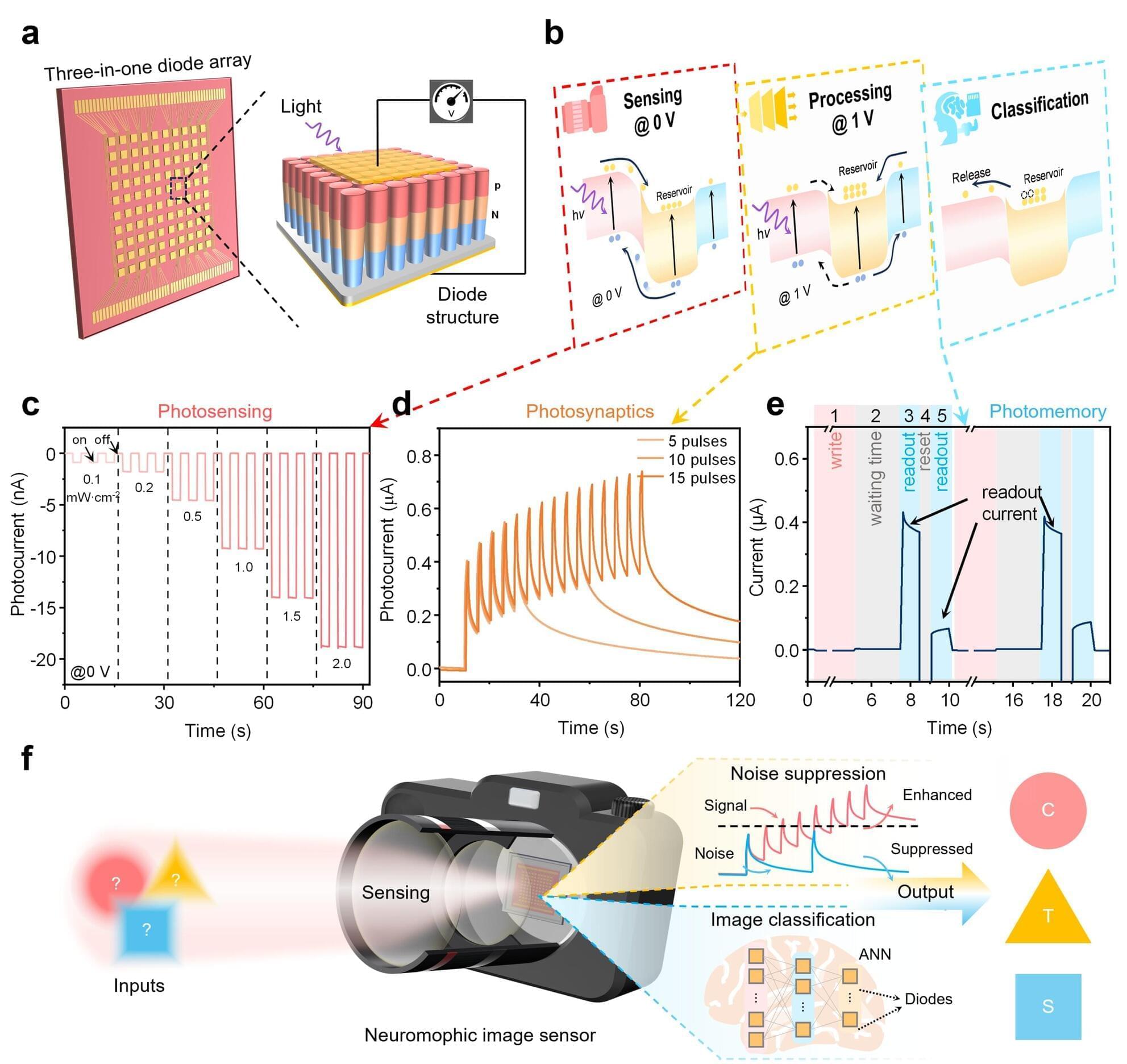
Think about how easily you recognize a friend in a dimly lit room. Your eyes capture light, while your brain filters out background noise, retrieves stored visual information, and processes the image to make a match. It all happens in a fraction of a second and uses remarkably little energy. Unfortunately, artificial vision systems in smartphones, cameras, and autonomous machines operate more like an assembly line. In our recent paper published in Nature Electronics, we describe how we addressed this challenge by enabling sensing, memory, and processing within the same device, pointing to a possible route toward more efficient machine vision.
The iGaN Laboratory led by Professor Haiding Sun at the School of Microelectronics, University of Science and Technology of China (USTC), in collaboration with multiple institutions, developed the multifunctional semiconductor diode with integrated photosensing, memory, and processing capabilities.
To understand the challenge, it helps to look at the basic building block of modern digital cameras: the semiconductor p-n diode. These tiny junctions act as the light-sensing pixels in imaging systems. However, a conventional diode is usually limited to a single function. It converts light into an electrical signal, and the captured data must then be transferred to separate memory and processing units. Moving this data back and forth consumes time, power, and chip area.