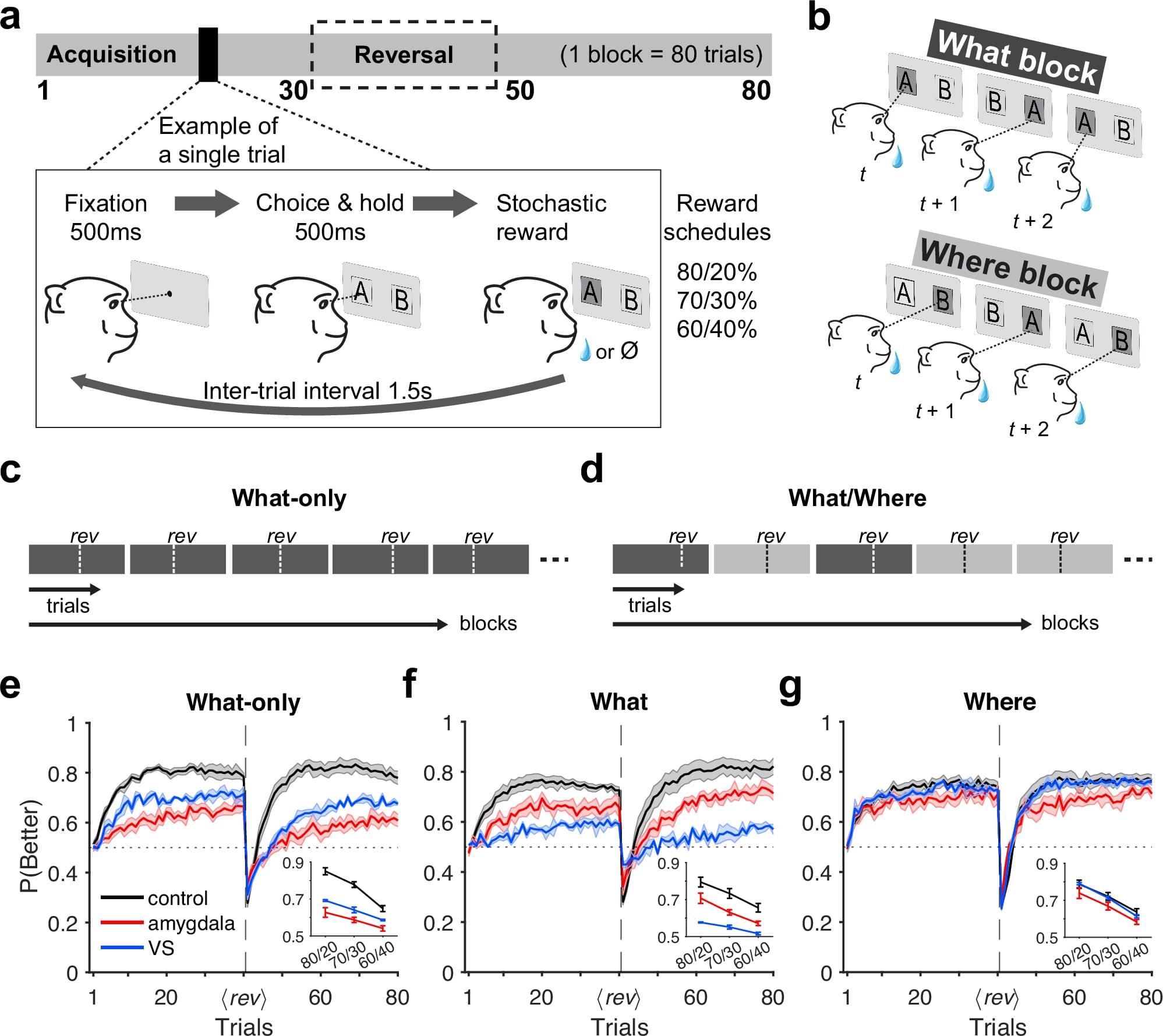
A Dartmouth study challenges the conventional view that the amygdala—the two-sided structure deep in the brain involved in emotion, learning, and decision making—is simply the brain’s primitive “fear center,” reflexively driving us to avoid the things we fear, from high places and tight spaces to spiders and large crowds. The researchers report in Nature Communications that the amygdala is far more complex, acting as a sophisticated arbiter to help the brain choose between competing strategies for learning and decision-making.
“Historically, the amygdala has been studied from the perspective of fear learning, and it has been generalized to reward learning,” says Jae Hyung Woo, a Ph.D. candidate in the psychological and brain sciences and the study’s first author. “Our main hypothesis was that it must have other functions given its extensive connections to the rest of the brain.”