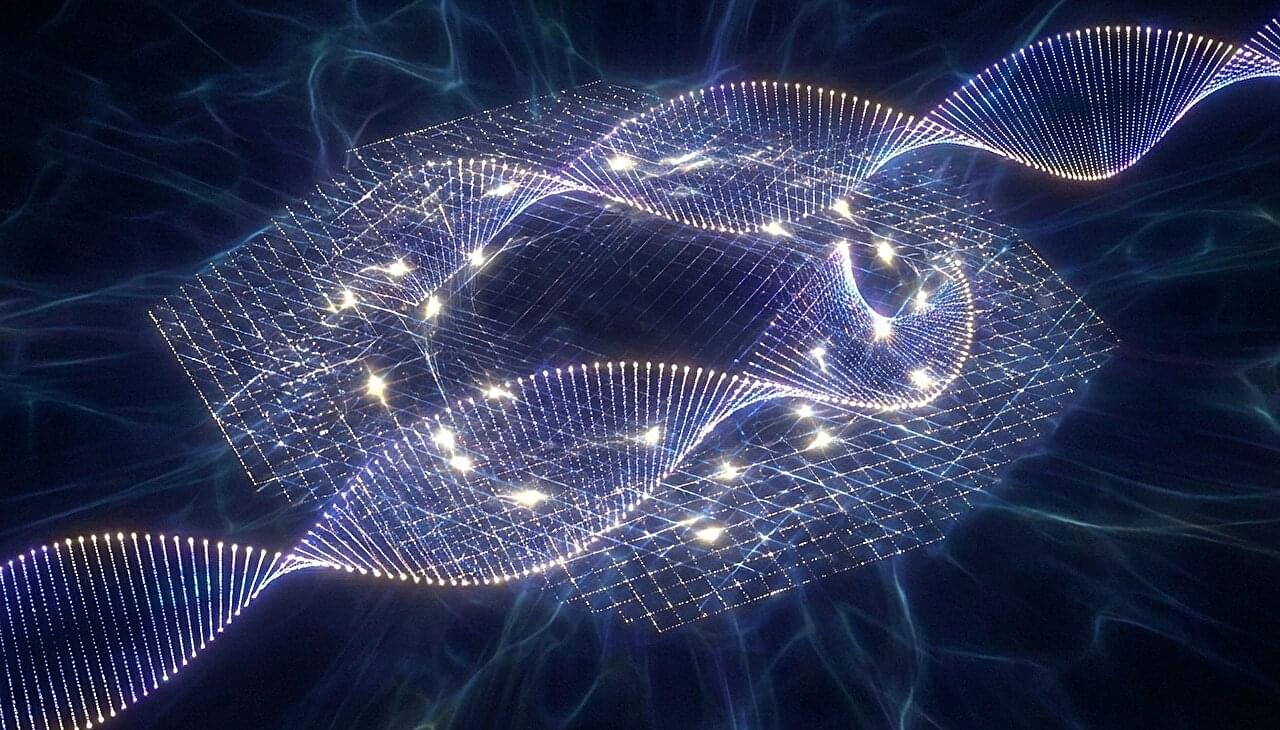
Conventional crystals are materials in which atoms arrange themselves in repeating spatial patterns. Time crystals, on the other hand, are phases of matter characterized by repeating motions over time without constantly heating up, breaking a physical rule known as time-translation symmetry.
Researchers at East China Normal University and Shanghai Jiao Tong University recently predicted the formation of a new type of time crystal, dubbed a two-dimensional (2D) moiré time crystal. This crystal was theorized to emerge when periodic perturbations (i.e., regular, repeated disturbances) are applied to ultracold atoms held in a smooth, continuous trap, as opposed to an optical lattice trap. The paper is published in the journal Physical Review Letters.
“We were inspired by two exciting concepts in physics,” Keye Zhang, professor at East China Normal University and co-senior author of the paper, told Phys.org. “The first is the concept of ‘twistronics,’ where twisting atom-thin layers creates moiré patterns with exotic material properties. While the second is that of ‘time crystals’ (a new phase of matter with persistent rhythmic motion). We wondered: could we combine these ideas by treating time itself as a dimension that can be ‘twisted’?”