Quantum computers, computing systems that process information using quantum mechanical effects, could outperform classical computers on some computational tasks. These computers rely on qubits, the basic units of quantum information, which can exist in multiple states (0, 1 or both simultaneously), due to quantum effects known as superposition and entanglement.
Many of the quantum computers developed in recent years are based on conventional superconductors, materials that exhibit an electrical resistance of zero at extremely low temperatures. To operate reliably and exhibit superconductivity, circuits based on these materials need to be cooled down to millikelvin temperatures.
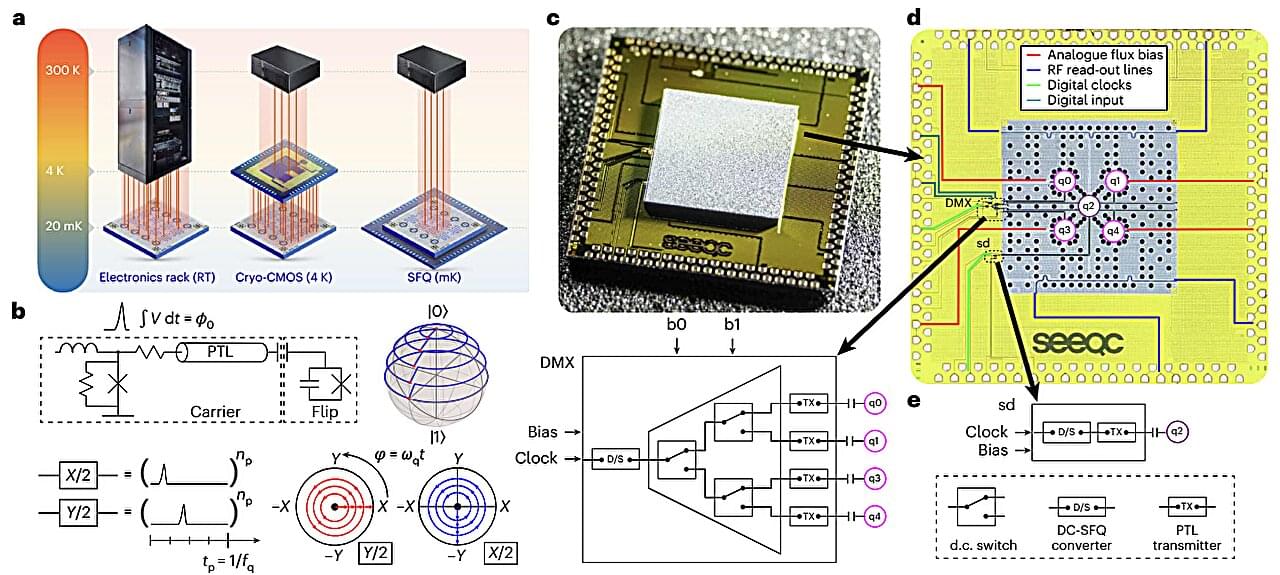
In quantum computers, each qubit typically requires its own control line. This means that engineers need to introduce several wires that carry electrical pulses (i.e., signal lines), and the number of necessary wires increases with the number of qubits. As quantum computers grow larger, this can be problematic, as processors become harder to build and reliably operate.