Superconductivity is a quantum state of matter characterized by an electrical resistance of zero and the expulsion of magnetic fields at low temperatures below a critical point. Superconductors, materials in which this state occurs, have proved to be highly advantageous for the development of various technologies, including medical imaging devices, particle accelerators and quantum computers.
While superconductivity typically only occurs at extremely low temperatures, recent studies showed that in some materials it can arise at higher temperatures. These unconventional superconducting materials are referred to as high-temperature (high-Tc) superconductors.
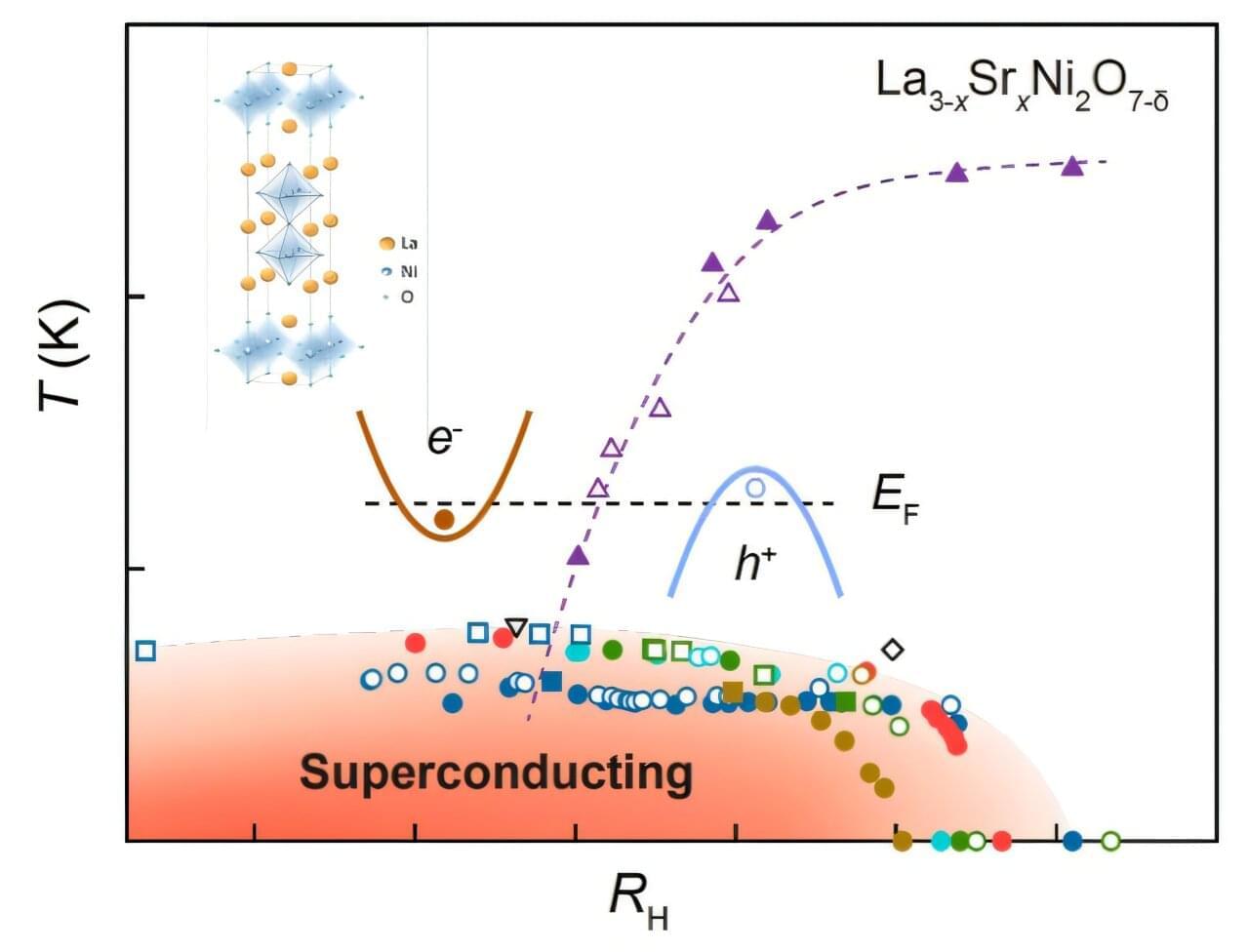
Researchers at the National Laboratory of Solid-State Microstructures and Nanjing University recently gathered hints of high-Tc superconductivity in a thin film nickelate, a material that contains nickel and oxygen arranged in a thin layered crystal structure. Their paper, published in Physical Review Letters, maps the evolution of physical states in these materials under different conditions, unveiling a so-called “superconducting dome” in this phase diagram, which is associated with high-Tc superconductivity.